Every sustainability professional in the built environment knows the pattern. For decades we put up buildings without seriously asking what they'd cost in energy, carbon or resilience - and we've spent years, and billions, correcting that after the fact. Now the same story is starting with data centres, only faster and with more capital behind it. The difference this time: the resources at risk are water and critical minerals.
Here's what genuinely worries me: this time we can actually see it coming. So the question isn't "did we know?" It's "what did we do while we knew?"
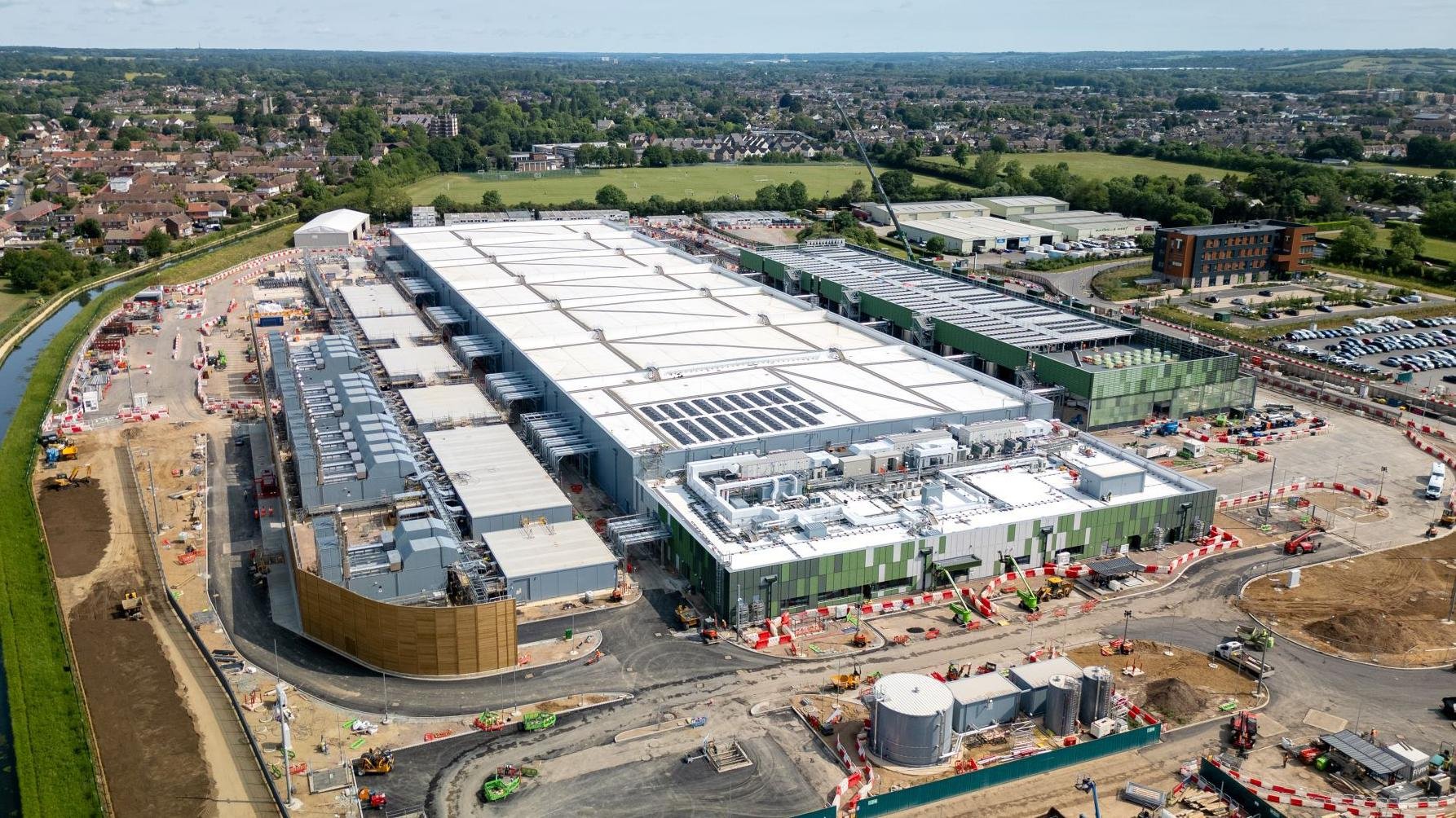
Google building data center in Hertfordshire, UK (Image courtesy: BBC)
Part one: the water we can't yet count
The UK recorded 509 data centres as of March 2026, with the heaviest concentration in London (written evidence to Parliament, DCU0042). In September 2024 the government designated them Critical National Infrastructure (CNI), and since July 2024 roughly £45 billion in private investment has been committed (House of Commons Library briefing, Data centres: planning policy, sustainability, and resilience, May 2026). The energy regulator reported that 140 data centres have signalled they want to plug into the grid, collectively requiring around 50 GW — more than peak British electricity demand on a winter day (Reuters, Feb 2026).
On water, the headline number looks modest until you read the second sentence. Current data-centre potable water consumption in England is estimated at around 1.88 million m³/year — about 0.2% of the non-household market — but it's on a clear upward trend, and just six facilities account for roughly 65% of the sector's use, most having come online in the last few years (WRc study for the Strategic Panel, via MOSL, Feb 2026). Treat these as directional estimates, not audited totals — which is itself part of the problem.
The deeper issue is where this is landing. Global Action Plan reported in April 2026 that 84% of proposed UK data centres are slated for water-stressed areas, much of it in the already-parched South East (Water Magazine). That report cites a Thames Water estimate that, under high-growth scenarios, around 30% of new water demand in that area could come from data centres — on the order of 270 million litres a day (Environment Journal).
This is set against a country where Environment Agency warns of a national shortfall of roughly five billion litres a day by 2055; and this projection doesn't yet fully factor in AI-driven demand (Business & Human Rights Resource Centre). We are regulating what we can't measure. Data centres aren't required to disclose water use, so the Environment Agency isn't fully factoring the sector into its risk planning (WRc full report, Water Efficient Data Centres).
We spent a decade in construction insisting "you can't manage what you don't measure" about embodied carbon. Same sentence, now happening for new sector.
Part two: the minerals we're barely discussing
If water is the resource story the UK has started to notice, minerals is the one it hasn't. Most of the impact sits inside the building, in the kit, not in the concrete.
Start with the demand curve. By 2030, AI data centres are projected to drive roughly 2% of global copper and silicon demand, over 3% of rare-earth elements, and around 11% of gallium (IEA Global Critical Minerals Outlook 2025, summarised via Springer/AI4S 2025). The World Economic Forum notes data-centre capacity could exceed 100 GW by 2030 — nearly double today's base — with an AI-driven shift toward more mineral-intensive equipment, and gallium and germanium already saw 25–30% price spikes after 2023–24 export restrictions (World Economic Forum, Dec 2025). This is no longer a chip story; it's a mine-to-data-centre story spanning copper, aluminium, rare-earth magnets, germanium fibre optics, gallium semiconductors, plus lithium, cobalt and graphite for battery backup. And btw, these mines come with significant social impact and labour right issues!
Then there are ethics, which are unavoidable. These supply chains are geographically concentrated and geopolitically loaded: China controls an estimated 60–70% of rare-earth mining and over 85% of refining (Cross-Dock Insights), and in late 2025 introduced sweeping new export controls on rare-earth materials and the products made with them — explicitly naming AI data centres among the affected sectors (IEA commentary). Mining and processing these minerals carries its own footprint — habitat destruction, water use, waste and emissions (per the Springer analysis above) — meaning a data centre's water problem partly hides upstream in the water used to extract its materials. Governments are now scrambling to respond, from the UNCTAD Global Trade Update, June 2026 to the new Quad Critical Minerals Initiative Framework.
And then the part the sector most wants to look away from: e-waste and the refresh cycle. Traditional servers ran 5–7 years. AI accelerator fleets are now being replaced every 18–36 months — sometimes every 12–18 for training clusters — because each GPU generation brings a fundamental architecture jump, not an incremental bump (STS ITAD analysis, citing Gartner and Dell'Oro, 2026). Against a backdrop where the world already generated 62 million tonnes of e-waste in 2022, heading for 74 million by 2030 (Pulse / Global E-Waste Monitor), the AI hardware wave means dense, valuable, short-life components with, too often, no clear end-of-life pathway (Knowledge Hub Media). One consultancy figure — widely repeated but not traced to a named study, so cite it carefully — puts around 85% of a data centre's embodied carbon in its mechanical, electrical and IT systems (POST note, What are data centres and how sustainable are they?, 2026). Circularity of IT and MEP kit isn't a footnote here. It's most of the impact.
The regulatory scaffolding is starting: the EU's Digital Waste Shipment System (DIWASS) became mandatory in May 2026, and the Basel Amendments now govern cross-border e-waste movement. But design-for-disassembly, modular hardware, and reuse are still the exception, not the norm.
The protests are a signal, not noise
On 27–28 February 2026, Global Action Plan coordinated national "Stop Dirty Data Centres" days of action, including a "March Against the Machines" outside OpenAI's London offices (Global Action Plan; The Ecologist). Local campaigns are live at Iver Heath in Buckinghamshire — where permission is being legally contested over a missing environmental impact assessment — and East Havering in Essex (Computer Weekly), and at the old Truman Brewery on Brick Lane (Socialist Worker), part of a wider international backlash (Wikipedia).
The framing is explicitly about equity: large AI facilities drawing on tap water and rivers while households face hosepipe bans and rising bills. Whether or not you agree with every claim, the point about social licence is one the built environment should recognise instantly. Support for data centres nationally sits around 52% but drops to 44% locally (POST note) — the classic signature of infrastructure whose benefits flow outward while its costs stay local. Historically, operators even treated water use as a trade secret (University of Oxford Engineering case study), which tells you how the transparency deficit began.
What else we've missed — the impacts hiding behind water and carbon
Even a piece on water and minerals leaves real issues on the table. Briefly, the ones I'd want on any honest scorecard:
Backup diesel and air quality. Most data centres rely on diesel backup generators. Run-hours are normally low, but Parliament's own evidence warns the emissions implications aren't formally modelled or built into carbon budgets or energy-security planning — a risk that becomes material as the sector scales and as operators may be forced off-grid at peak demand (written evidence DCU0076, May 2026). Given the concentration of sites in London, if generators ran simultaneously the local air-quality hit would be significant (Computer Weekly). Cleaner options — batteries, HVO, hydrogen, fuel cells — exist and some UK operators are already using them, but they're not yet the default (Data Centre Review).
Energy displacement and the grid. The bigger climate question isn't diesel; it's whether Britain can build enough genuinely additional clean power and network capacity in the right places, fast enough — or whether new demand leans on residual gas and locks in avoidable megatonnes of CO₂ (Tim Harper, Can the UK Grid Handle the AI Data Centre Power Boom?). Done well, data-centre investment can accelerate grid decarbonisation; done carelessly, it competes with housing and everything else for connections.
PFAS, noise and land. The POST note flags "forever chemical" PFAS in some cooling fluids and electronics, persistent noise from cooling systems and generators, and the land take of large campuses — none of which show up in a carbon or water metric (WRI's US analysis documents the same cluster of community-level impacts).
Biodiversity and "data waste." Large campuses and new transmission lines carry habitat and land-use consequences that DEFRA and environmental bodies are, per the parliamentary evidence, not meaningfully involved in weighing. And there's the demand-side point experts keep raising: inefficient data management and hoarding of low-value data ("data waste") inflates the storage and compute we build in the first place.
There is genuine hope - and it's further along than the doom narrative suggests
Real work is happening. The WRc study, the House of Commons Library briefing, the POST note, and the National Engineering Policy Centre's Water use in AI and Data Centres together built a serious evidence base in about twelve months.
Concrete policy asks are on the table: mandatory granular reporting of energy, water (split potable/non-potable) and carbon above a power threshold; developer–water-company–local-authority coordination as we already do for electricity; and removing barriers to reclaimed water (techUK, Understanding data centre water use in England).
Industry commitments exist too. The Climate Neutral Data Centre Pact sets PUE, clean-energy and water targets with independent auditing and an expulsion clause for signatories who miss them (Wikipedia), and techUK negotiated a sector Climate Change Agreement target of 14.5% energy-efficiency improvement on a 2022 baseline by 2030 (techUK).
The built-environment bodies are engaging — though mostly on carbon, not yet deeply on water or minerals. UKGBC's Net Zero Whole Life Carbon Roadmap Progress Report 2025 — which bluntly found the sector "dangerously behind" — sets the frame; UKGBC, IStructE and RICS co-hosted the 2025 Embodied Carbon Summit; and academic work is applying UKGBC net-zero criteria to data-centre structures via Kao Data, Ark and Telehouse case studies (European Modern Studies Journal).
The honest gap: as of writing, I couldn't find a data-centre-specific whole-life water or materials framework from UKGBC, RICS, LETI or the UK Net Zero Carbon Buildings Standard. The building-side thinking is carbon-led; the water, minerals and e-waste thinking is coming from the water sector, engineering institutions, ITAD specialists and NGOs. Those conversations haven't met. And that gap is exactly the opportunity.
The provocation
For twenty years we told ourselves the retrofit crisis was unavoidable — we didn't know better at the time. That excuse is gone. On data centres we have the research, the protests, the parliamentary evidence and the policy asks before most of the concrete is poured. If we still build first and think later, it will be a choice, not an accident.
The built environment is fluent in whole-life carbon. We are not yet fluent in whole-life water, whole-life materials, or whole-life waste at this scale. That fluency is the work.
Questions I'd put to the industry
Where and which is the whole-life water assessment standard — one that counts embedded water in power generation and in upstream mineral extraction, not just on-site cooling? Who owns it?
Where is the materials-and-e-waste equivalent? If refresh cycles have collapsed to 18 months, why is design-for-disassembly and hardware reuse still the exception?
Should water availability be a hard siting constraint, not a soft material consideration? If 84% of proposed capacity is in water-stressed areas, is voluntary reporting a serious answer?
Can CNI status carry a disclosure responsibility? If data centres get preferential planning as critical infrastructure, should mandatory resource disclosure — water, energy, minerals, waste — be the price of entry?
Who owns the air-quality and diesel question before it becomes the next community flashpoint — and why isn't backup emissions modelling in carbon budgets already?
What does actual community benefit look like — heat reuse, water-positive commitments, local reporting — versus a plaque and a press release?
Are we, as sustainability professionals, prepared to say "not here, not like this" when the numbers don't stack up — or will we again optimise the details of something that shouldn't have been sited where it was?
We got one thing right this time: we're asking the questions while the ground is still open. Let's not waste that.
AI usage disclosure: AI was used to edit and refine the language for this article.