In India, basic health care needs are also hard to be accessed by the citizens in some regions. Moreover, rural areas in India face a shortage of more than 12,300 specialist doctors. There are vacancies for 3,880 doctors in the rural health care system along with the need for an astounding 9,814 health centers.
In my Masters in Policy analysis at TU Delft, with my colleagues, I worked on a cross-cultural study to understand if the best systems (UK and Netherlands) for healthcare insurance policies fit for India. Results: Such transfer of policies looked impossible as-is they are in India, i.e. if the policies are copied exactly from the UK or the Netherlands. It needs a lot of other policies in place first, and we try to look into such policies.
(Why) Do we need compulsory healthcare insurance for all?
We need it. Why? Statistics of our health are getting better, but inequality of its access is getting worse. An equitable distribution helps contribute to the health of a nation. Cross-subsidy system makes sure everyone get access to good health facilities.
Is it possible to make this equitable distribution considering the population and economic disparity we have? It is difficult, but not impossible if the economic levels are considered to define the type and applicability of insurance schemes. It should be noted that this is not a one time job to implement such nation-wide policy, but it is an iterative process.
How was this study carried out?
Comparative analysis between healthcare systems in Netherlands and the UK is done to chose the donor country. These two countries were announced as the countries with the best healthcare system in the world.
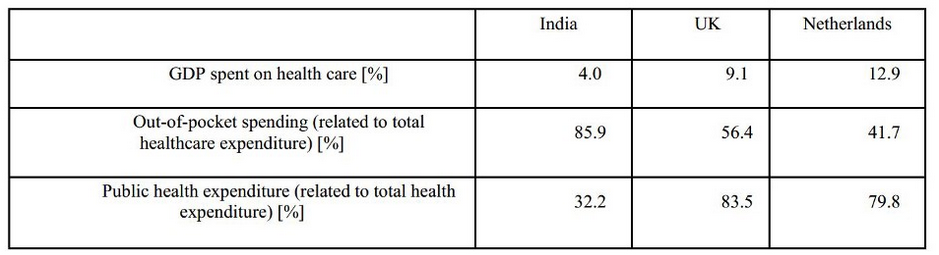
Comparison Between India, UK And Netherlands Health Care Financing System
Hofstede’s six cultural dimensions helps describe the effect of the culture of a community on their behavior and values. These dimensions were studied for UK and India (with family of nations perspective) and its implications/ feasibility on transplantation of healthcare financing policies was analysed.

Hofstede’s 6 Cultural Dimensions Comparison between India and United Kingdom show India and UK to have very different types of culture.
What can be the next steps?
People: Awareness about its need among people. People would feel this system as sucking money out of them for no reason (even when I am not ill, why I am obliged to pay?). But if they understand they are investing for their future, it is easier to convince a majority of people. Also if everyone understands the biggest picture, i.e. equality for health, you have convinced a major of the remaining crowd. Above all, this can be implemented in stages:
Make people aware about importance of health-care facilities
Charge less money as taxation which includes basic vaccination
Full provision of facilities by the government by involving an organisation like IMF, World Bank.
Government: A good collaboration between the local and central government is key to its success. Inefficiencies and corruption of middlemen delays the process. Direct implementation by central will make people feel forced by this policy and implementation by local government will introduce inefficiencies. So, the way out: Slow and steady process by local governments, which:
starts with a collection of local level population data (urban can be targeted first due to better awareness),
launching awareness schemes, and
then strict implementation by central policies
roles for governance should be divided in phases and should not be overlapping. Overlap would lead to higher inefficiencies and corruption than hand-overs.
Arranging funds: India won't be able to pull this itself. It would need either international organizations or direct support from countries with such established systems. In 2012, India was able to completely eliminate polio with the help of WHO, which proves example of benefits of outside force
Private companies: Co-payment system as established by the UK is a good example for sustaining the system with the private hospitals and insurance companies.
What measures ensure the success of such transfer of policies?
To make the transfer of policies from one culture to another possible, the new culture should have high practicality and high desirability for these policies and its implementation. This will be a highly acceptable transfer for the stakeholders in India, if the following conditions are fulfilled:
The debt from IMF is paid o on time by an increased healthy working population
The taxation is considerate of the incomes of people below poverty line and the system of free health care facilities for them continues.
There is no or under-control level of corruption in the proposed system
What will be the results?
More personal responsibility towards our own health.
Equality for health facilities access for all.
The complete extensive study as published can be found here. This study is included as a chapter in India’s service sector: Emerging perspectives, edited by Kawal Gill, K.V. Bhanu Murthy and published by M/S Athena Academic.