Why we urgently need more women in government in India?

Between 25th Feb to 27th Feb, 15 women with a passion to understand and potentially join politics, gathered at YWCA in Delhi for an in-residence workshop as a part of the “Women in Government” fellowship. This might be one of the only fellowships in India training women in politics, which is quite an important cause as “with just 14.3% women parliamentarians elected in the recent 2019 Lok Sabha elections, India is still much below the global average of 25.9%.”

The goal in this workshop was straightforward yet complex for the organizing team at Femme First Foundation to bring together and align a team of diverse women entrepreneurs, designers, engineers, politicians, political consultants, and folks from spheres of development to education, between the age group of 20-60, hailing from different regions of the country. I was lucky to be one of these 15 participants in this workshop (19 in the fellowship) to learn on the topics from equity in gender talks, to parliamentary processes and social campaign for joining a highly gender-biased space of Indian politics.
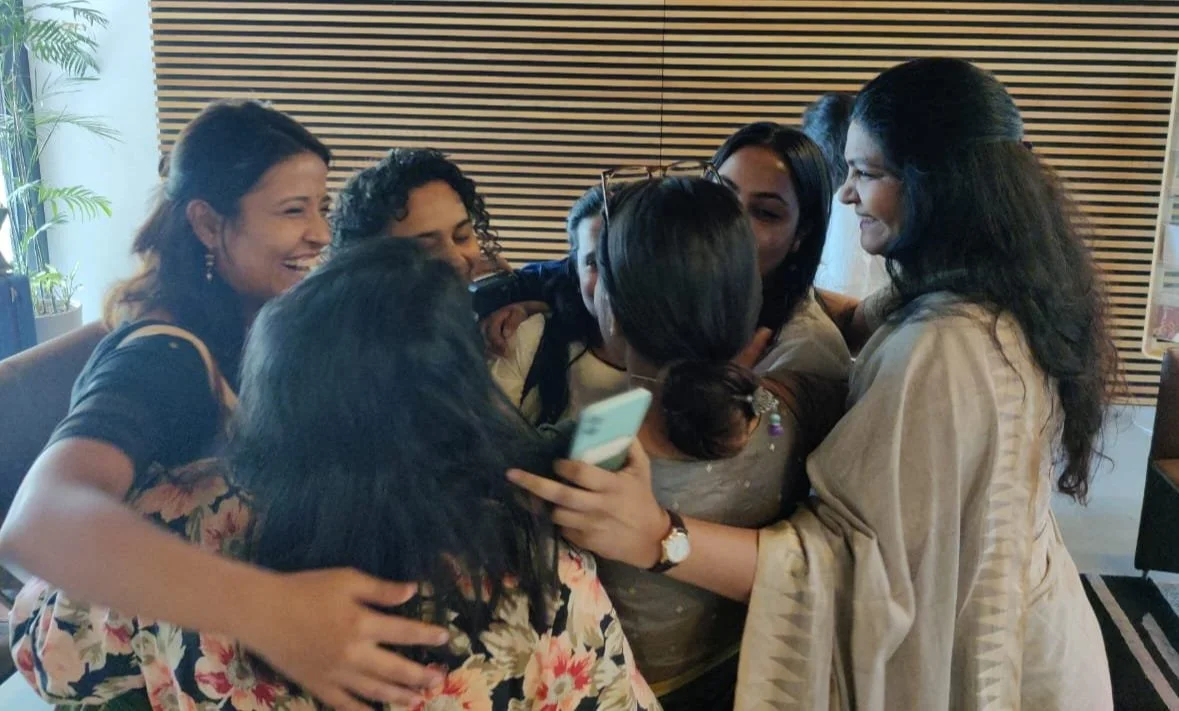
Some of the participants from the fellowship during the closing ceremony

The three main sections we were trained on during these sessions were (1) Intersectionality, social inclusion and gender equity, (2) Public narratives and storytelling , and (3) Parliamentary processes and social campaigning. But additional to these concrete lessons, there were many more learning which were possible only due to the presence of these dynamic 15 women learning together for a common cause, irrespective of their ideological and experiential difference.

Importance of social inclusion and intersectionality

Social inclusion and gender identities are widely discussed topics nowadays, but these sessions highlighted the importance of associating the right vocabularies to different systemic oppression for not just women, but also other underrepresented communities like lower caste, lower income and LGBTQIA+ communities. For example, we learnt how all matrilocal (a custom in marriage whereby the husband goes to live with the wife's community) and matrilineal (based on kinship with the mother or the female line) communities are not always matriarchal (a form of social organization in which a woman is the head, or in power), e.g. the Khasis communities of Maghalaya.

We also touched upon the idealistic gender neutral future, where biological sex is not necessarily determinant of the gender identity of an individual. After reading Kimberlee Crenshaw’s texts on intersectionality, we dived deep into the discussion on the social exclusions and how we should consider this for inclusive policy making. We also dwelled into our own personal privileges and discrimination, and creating our own stories of hope for public narration. This is extremely crucial training for political leaders of future, especially those who can put marginal voices on the forefront.

Parliamentary processes and social campaign

From PRS legislative research professionals, we were given an in-depth training on how parliamentary processes happen on a day to day basis - what do these ministers actually do from 9 am to 6 pm. We were explained different types of bills, how the bill goes through various houses and how does it become a rule and then a law. We learned the different parts of the bills which make them easy to understand and comprise of Statement of objects and reasons, Definitions, Clauses, Provisos or exceptions, Penalties and Delegated legislation. To enter the politics, additional to the knowledge on parliamentary processes, one of the important step is to run at lease few impactful and successful social campaigns. We worked on assignments on social campaigns in different groups using different tools like SWOT analysis and SMART techniques to create achievable concrete campaigns.

Unity in Diversity

Though all these trainings were super helpful and important for our future steps in politics, what really stood out was how each one of us with highly different lifestyle, experiences, region, education background and age group, could connect to each other’s stories of oppression as a woman to liberation (also as a woman) very easily. Most of the learning happened over the dinner tables and the walks in the Central Delhi, where we openly shared our strengths and weaknesses and prospects of how to grow with each other together. Many of our ideologies, even on women’s role/ privileges/ discrimination in society were different, but it didn’t stop us from still aligning on a common goal of bringing more women representative in Indian politics. For example, in the closing ceremony at Norwegian Embassy, we learnt about the Norwegian women struggle to equality in politics: how only when the prime minister brought in 50% women ministers on board and emphasized on need of “strong women uplift women, together”.

Closing notes

While the menstrual leave bill still hangs on thread with a completely male led committee, while the women reservation bill still remains a point of discussion in parliament (as not an important topic, because Adani and finance bills overrules everything), and while educated girls in India and the harassment against women and marginalized ones still remain record high, the call for women leaders become louder. There is no doubt we need more women in politics, on leadership, on representation, now, to build nurturing equitable communities of future.

Feminist Movements: Independence vs Freedom

As a child, I was told by my mother that I had to be independent & self-sufficient. I should never rely on anyone or on anything because her life became a life at mercy of many. She never wanted history to repeat itself and of course, she had very good intentions for me. As I grew up and moved to the tech schools, everyone around me was growing to be a strong independent tech woman. I chose to be the same and grew to be a strong independent woman, happily and fiercely. To the extent, that I really didn’t need anyone, for anything. But somewhere in this need for fierce independence, I started frowning upon any kind of dependence (labeling it as “toxic”). And with this notion, I reached an extent where I did not have a social system or friends who truly mattered, or family with whom I really checked in (or who checked back at me); I was truly “ïndependent”.

No doubt, this piled up my everyday tasks (as I had no one to share the mental or physical burden with) and I started getting exhausted, irritated, and burned out. Even after successful higher studies degrees, successful designations, working for establishing organizations, and winning multiple awards, I became a classic case of depression in my mid-20s.

I started therapy, slowed down on things, had another physical and mental breakdown again, re-started therapy, and re-slowed things. As therapy helped me evaluate my needs, I learned to communicate better and rely more on others whenever needed. And I saw through all these falls, that the only thing which saved me, which allowed me to truly start with the painful process of healing was to depend on actual human beings, who let me depend on them, let me be comfortable in my own skin.

"Rarely, if ever, are any of us healed in isolation. Healing is an act of communion." Bell Hooks, from All about love, p. 215.

This experience has made me re-think the need and definition of fierce independence. Also, I am appalled by the subjectivity of this definition for a man and anyone-who-does-not-label-them-as-man. An independent man can still rely on a wife or a mother or a partner who cooks for him and is still labeled as independent for carrying out his normal daily work. While, an independent woman doesn’t have the luxury of that, because an independent woman is not “independent enough” if she asks for help for daycare of her child from anyone else. A woman becomes independent only at the cost of the community’s burden and tasks.

We need to start embracing that we are a social breed. We live in communities, and we grow and nurture in communities. We thrive and grow together. We can only survive together. And the pressure for anyone among us to do this completely independently, and on our own, puts us under pressure to do this alone, which is unfair and impossible (without a breakdown or burnout).

The narrative which was written by the feminist movements or at least envisioned by them was to help the women feel freedom (of thought, of expression, of choices), and not just independence. It is far away from the isolation and the pressure, which young women have started experiencing in the community today due to the skewed definition of independence. Can we as a generation try to work more towards freedom again, and try to lean on each other again to get our freedom back!

How inequity triggers mental health issues?

Originally published here: www.humanewarriors.in/post/how-inequity-triggers-more-mental-health-issues

Yesterday, while on a call, something which hit me personally, and at the same time, made me realize how systemic this ‘personal’ feeling was. The call was with Ayushi, a member of One-step many smile (OSMS) foundation. Their foundation is doing something amazing - they are helping the complete community to cope with stress during these uncertain COVID-19 lockdown times. They do this through multiple methods including narrative therapy and creating women self-help groups (Mahila Mandal), but I will get into details of them soon.

I talked with Ayushi and got to know about the work of OSMS while working on our hunger-relief and post-COVID relief project (Humane Warriors). We worked together in the region of Ghaziabad for helping around 200 families with monthly ration kit supplies, as they were not able to afford basic supply due to the COVID-lockdown and lost daily wage. She mentioned how they were also including mobile recharge as one of the components of their ‘ration kit’ (additional to food). What OSMS was providing was a basic recharge, which means access to simple phone calls. Now take a pause and imagine how this would look like – a lockdown time, with bare minimum food supply, constant worries, no way to get out of home – and above all this, no way to have a single way to cope with the stress (which we so easily do by calling and cursing that one friend). No hope. No doubt this would accumulate towards a worsened mental health.

Orange Restaurant Photo Collage Food Facebook Cover (1).png

And then I could see something very clearly - I was too privileged to even realize what this meant. Personally, I knew of many of my friends and family (including myself), who were dealing with a lot of mental stress due to the lockdown and uncertain times, but at least all of us had the privilege of distraction -> we could take zoom calls (unlimited time), and use the unlimited streaming options of movies to series (Netflix, just for starters).

To many of the readers, this would sound as a very ‘first-world’ perspective to a developmental issue. But this is where we need to change our perspective and understand that good mental health is equally important for all. Give a read of these news articles - Suicide of a teenage girl due to lack of access to the internet and online classes, Suicide of migrant labor due to loss of job, no way to reach back to the family during the pandemic. These news articles just represent a tip of the iceberg - as most of this news is never reported, or never brought to limelight when compared to a demise of a Bollywood actor (with potentially the same reason).

Overall, this call made one thing very clear to me – when we are looking at inequity and its various symptoms – something, which we have ignored heavily, is the mental health issues awareness and a divided approach to deal with it, across the society. This in no way means that someone’s stress in society is lesser than another – it just means that someone who is battling even the basic necessities might be having a much harder time to cope with their personal mental (and obviously, physical) health issues. This is already noted by the World Health Organization (WHO). They have identified stress determinants of an entire community, which could be completely different based on their socio-economic condition e.g. with conditions like employment status, social exclusion, gender equity, etc. For example, the marginality and social exclusion of a community (from lack of resources like food to lack of community-ties) can make the members of the community more susceptible to certain diseases.

So what is the solution to this? How do we tackle this problem which lies in the foundation of our societies – especially, for a country like India, where inequity lies in every sphere – from social (gender, caste, etc.) to economic (income, regions, etc.) spaces? Something, which OSMS is doing, is taking some simple steps of measures with a community-as-whole approach for community mental health development. What they envision is to develop strength of entire community, e.g. (1) by supporting with their basic resources (e.g. what we did together with the hunger relief project) to relieve the stress, but also (2) by questioning which are the further stress determinants of the entire community -which need to be taken care of. One example which Ayushi gave me was how they do frequent check-in calls with the community members, just asking them questions like ‘how are they doing’ (isn’t it simple? Like the way you do with your friend who is in distress). These are not meant to be any form of diagnosis calls – but just a show-of-support towards the community.

And then I could see something very clearly - I was too privileged to even realize what this meant. Personally, I knew of many of my friends and family (including myself), who were dealing with a lot of mental stress due to the lockdown and uncertain times, but at least all of us had the privilege of distraction -> we could take zoom calls (unlimited time), and use the unlimited streaming options of movies to series (Netflix, just for starters).

To many of the readers, this would sound as a very ‘first-world’ perspective to a developmental issue. But this is where we need to change our perspective and understand that good mental health is equally important for all. Give a read of these news articles - Suicide of a teenage girl due to lack of access to the internet and online classes, Suicide of migrant labor due to loss of job, no way to reach back to the family during the pandemic. These news articles just represent a tip of the iceberg - as most of this news is never reported, or never brought to limelight when compared to a demise of a Bollywood actor (with potentially the same reason).

Overall, this call made one thing very clear to me – when we are looking at inequity and its various symptoms – something, which we have ignored heavily, is the mental health issues awareness and a divided approach to deal with it, across the society. This in no way means that someone’s stress in society is lesser than another – it just means that someone who is battling even the basic necessities might be having a much harder time to cope with their personal mental (and obviously, physical) health issues. This is already noted by the World Health Organization (WHO). They have identified stress determinants of an entire community, which could be completely different based on their socio-economic condition e.g. with conditions like employment status, social exclusion, gender equity, etc. For example, the marginality and social exclusion of a community (from lack of resources like food to lack of community-ties) can make the members of the community more susceptible to certain diseases.

So what is the solution to this?

How do we tackle this problem which lies in the foundation of our societies – especially, for a country like India, where inequity lies in every sphere – from social (gender, caste, etc.) to economic (income, regions, etc.) spaces? Something, which OSMS is doing, is taking some simple steps of measures with a community-as-whole approach for community mental health development. What they envision is to develop strength of entire community, e.g. (1) by supporting with their basic resources (e.g. what we did together with the hunger relief project) to relieve the stress, but also (2) by questioning which are the further stress determinants of the entire community -which need to be taken care of. One example which Ayushi gave me was how they do frequent check-in calls with the community members, just asking them questions like ‘how are they doing’ (isn’t it simple? Like the way you do with your friend who is in distress). These are not meant to be any form of diagnosis calls – but just a show-of-support towards the community.

photo-1542315099045-93937d70c67a.jpg

The larger goals of OSMS include developing a sense of strength and solidarity towards each other within the community so that there would be a sense of equity and belongingness amongst themselves. They have already started seeing the effects of these measures – where they have examples of community members trying to support those in maximum needs, over their own personal needs. The introduction of narrative therapy has helped community members to start looking at their set of personal skills over their problems and potentially develop better/ new identities to deal with their stress. The same targets have been achieved by Mahila Mandal or women self-help groups where women share their issues and also resources, within the community. OSMS envisions building a larger framework out of this and developing community leaders via training of the members.

The work of OSMS definitely sounds like hope for communities that we easily tend to forget. However, these are just the first steps towards tackling one of the symptoms of our systemic economic inequity. Unfortunately, those who face these issues, have either no access, no means, and in worst cases, no personal will (or just plain feeling of embarrassment, due to their situations) to share their stress. So let’s take more steps towards sharing within community, without judgments of where they come from or of their current situations – to move towards an empathetic and humane society.

COVID-19: A campaign beyond fighting corona

Originally published on the Namaste Switzerland Magazine

(co-authored with Naveen Samshudhin)

As we video conference for work, attend virtual yoga and meditation sessions, dine via Skype with family, with food stocked at home; we forget that large-scale lockdowns without providing social security measures can kill an unimaginable number of the world’s poor through hunger even before the virus appears.

At midnight, on March 25, 2020, a 21-day lockdown was imposed in India, effectively immobilizing 1,300 million of its citizens – the world’s largest lockdown. As we know, the majority of people we meet on the streets of India are daily wage workers and street entrepreneurs. They form the backbone of the informal economy, doing everything from selling ‘chai’, fruits, food, clothes, polishing your shoes, driving rickshaws and delivering goods, cleaning homes, etc. A lockdown implies an inability to work. This means effectively cutting off the daily income of hundreds of millions of people and their families.

“Social distancing is not an option for India’s poor” warned Slate.com – one day before these lockdowns. BBC reported on Day 0 of the lockdown that India’s poor fear that hunger may kill them before the coronavirus does.

Shocked by the societal implications of the three-week long lockdown on the most vulnerable of India’s population, we knew we had to do something – and do it fast.

TAKING CARE OF HUNGER IN THE TIMES OF COVID19 THREAT

On Day 1 of the lockdown, after a quick brainstorming call, we decided to launch a Swiss-India initiative on combating hunger, the need which we found the most pressing, and within our reach to impact.

We chose our close and trusted network in India, beginning with friends, family, and their friends, to help identify those who are extremely vulnerable to this crisis, or would go hungry in the coming days, and hand them over cash and/or food and sanitary supplies to help them sustain themselves for the next 3 weeks. The strategy was to catalyze a bottom-up process, starting from people acting within their local neighbourhoods and within their spheres of compassion, and then replicating it across various towns and cities, which we believe complements the government’s top-down measures and initiatives.

Here in Switzerland, we started an international fund-raising campaign through a crowdfunding platform. Within eight days (by Day 9), we were able to raise CHF26,000 (or INR 20 lakhs).

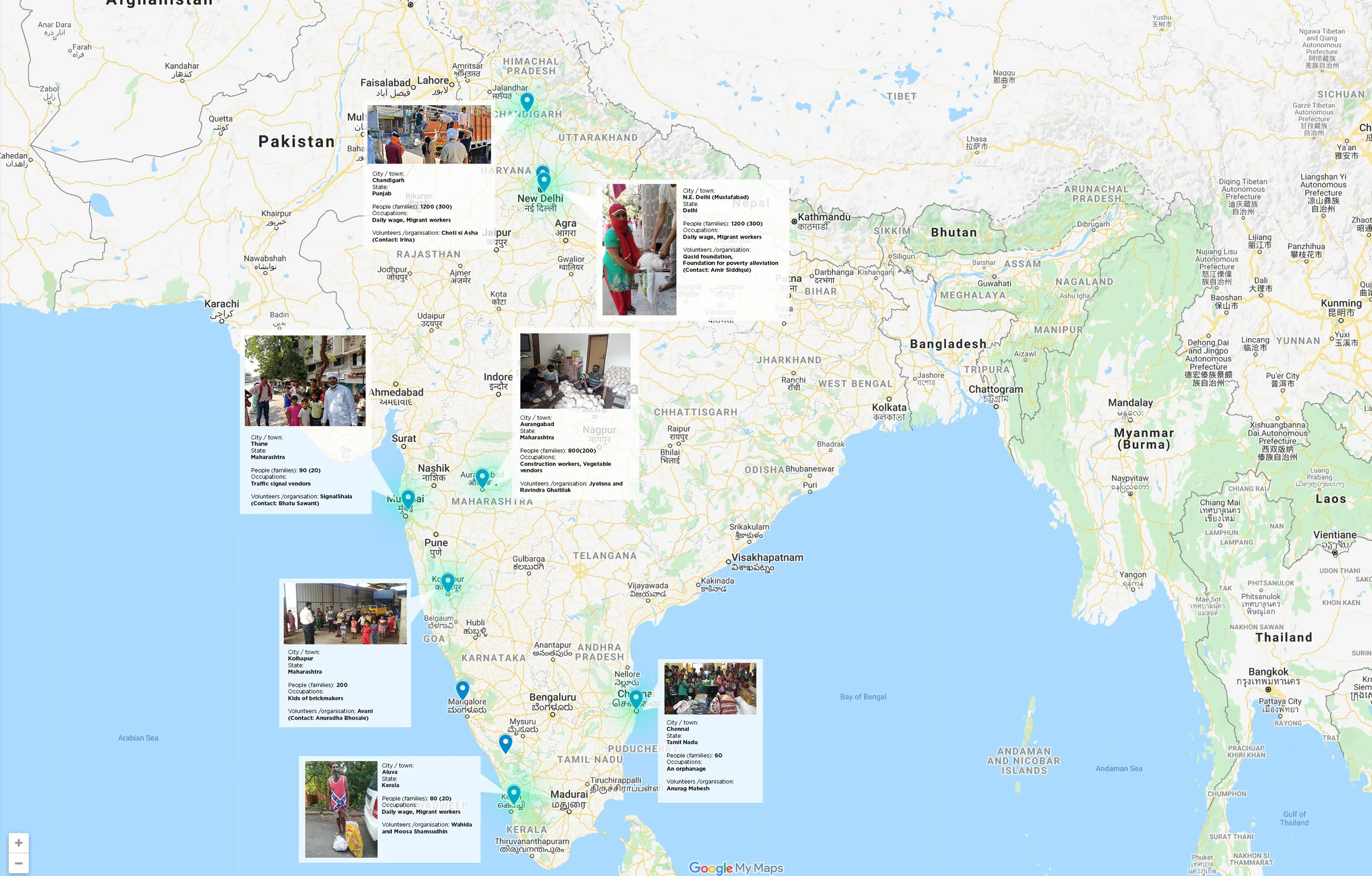
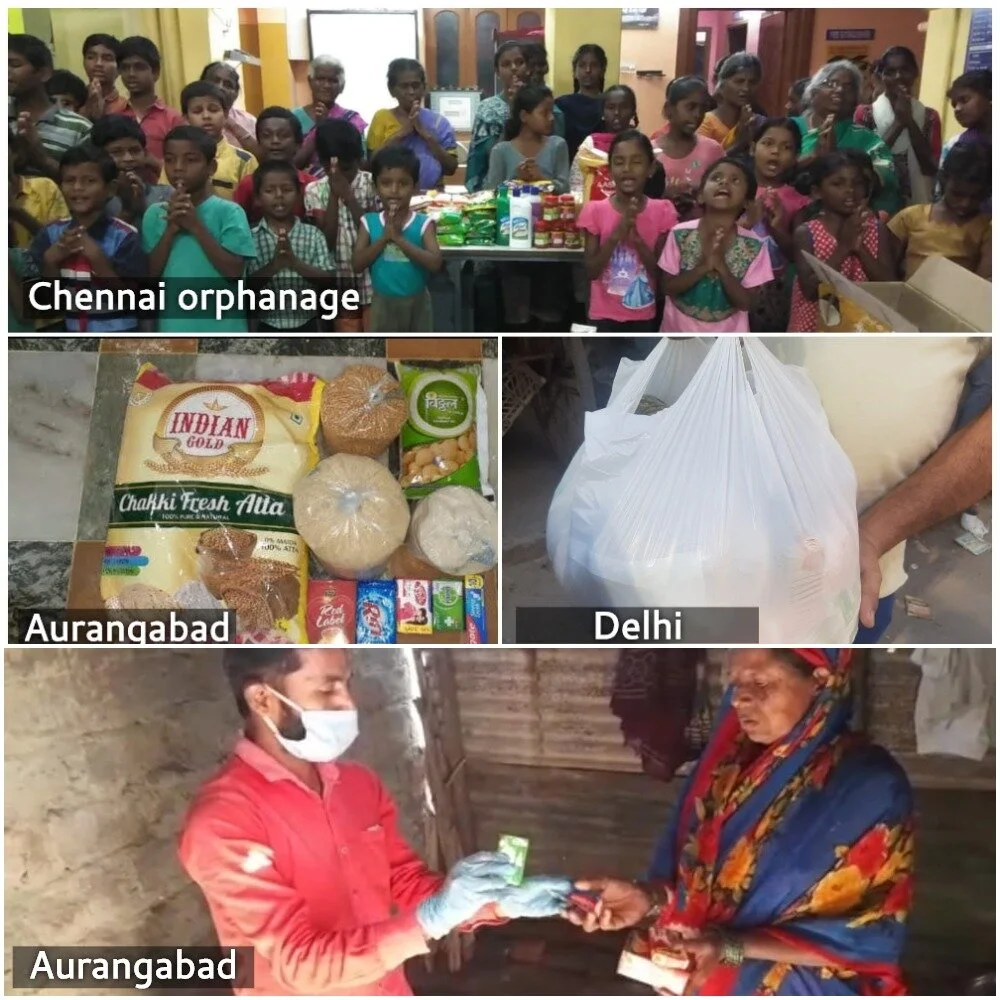
We had already started mobilising and coordinating with the volunteers on the ground and by Day 4, we were able to deliver food and sanitary kits to more than 200 families of construction workers, rickshaw drivers and vegetable vendors in Aurangabad (Maharashtra). By Day 6, we managed to supply food and sanitary kits to more than 200 families in Delhi and Chandigarh, 17 families in Kerala, and an orphanage in Chennai.

This is just the ‘tip of iceberg’ as one of our volunteers, rightly said. We are getting requests from our volunteer teams in India on a daily basis and now we need to support at least 1500+ additional families in the coming week.

This needs an extreme level of coordination of distribution of funds on our side, a sprinted effort from the volunteers in India, and also close support from people in Switzerland and those outside India. Hence, we are keeping our crowdfunding campaign open till this Thursday, 9 April 2020.

Do support us as every franc counts! By donating and sharing this campaign further, we can impact the underprivileged and ensure they remain at their homes without having to risk their lives to bring food to the table!

We have developed a transparency report and a daily project update page which can be found here: http://www.tinyurl.com/India-corona-fundraising.

Get in touch with us.

A HUGE LEARNING EXPERIENCE

This project which started as a personal cry for action, has developed into something much bigger and inspiring than we expected. It is definitely a huge learning experience for the both of us, and for the teams we work with in India.

We are learning to creatively deal with uncertainties, and every day presents us with new challenges – this means we have to keep iterating and improving our strategy constantly.

We do not want to stop at distributing the foods and supplies to those in need, but also extend to implement best practices for volunteer groups involved in pandemic situations. We are looking forward to working with local authorities and the government, to make this a smooth transition for them as well – and to reach the 400 million daily wage workers, with their initiatives.

This virus, and the widened inequality in these times needs all of us to stand in solidarity and fight together.

FIGHT AGAINST HUNGER AND CORONA WITH US

Volunteers and projects

Volunteers and projects

Here’s how:

  1. Donate to our association account, Kaleido Verein Zurich, IBAN: CH02 0900 0000 6139 4938 8, Postfinance Bank (BIC: POFICHBEXXX)

  2. Donate directly on our new website: Justice Warriors. All donations in INR accepted.

  3. Donate to Fight Hunger, Fight Corona Campaign by Sunday, 26th April 2020

Women are fighting their homes - are we ready?

Unlike the high hopes - 2020, a new decade - did not start merrily. The news was - from west to east, north to south - plain depressing. Australian fires killed more than 500 million animals. The Indian authoritarian regime attacked innocent students in universities protesting an unsecular law - the aftermath of which killed more than 25 civilians and injured 100s. South America to Hong Kong faced protests, injuring many. In spite of how geographically distant these problems were, they had a strong common resistance - young women fighting the home regimes, for their homes. 

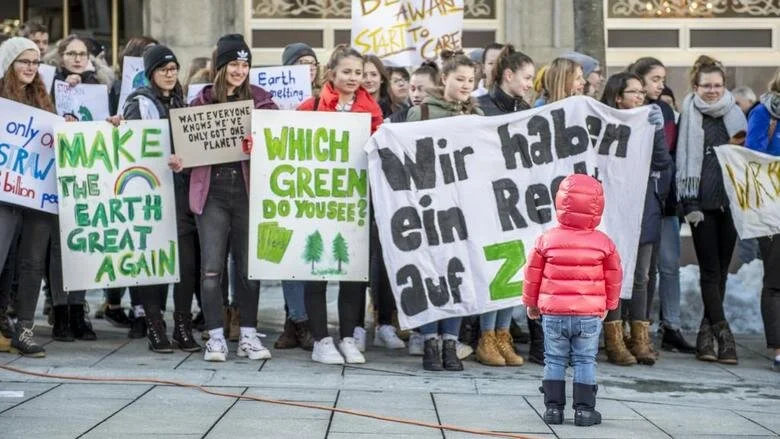
Greta Thunberg from Sweden became the symbol of action for tackling climate change. In December 2019, at Madrid at COP25, in front of more than 150 country leaders, she bluntly stated the extreme frustrations of the youth with the world leaders. And she has done this for many years now, from the mere age of 8 years. But she took the first bold steps of this resistance - at home, by resisting every Friday in front of her home parliament - emphasizing the cost of inaction towards climate change

Flavia Kleiner from Switzerland co-founded the liberal group, Operation Libero. This group has fought many conservative initiatives by the Swiss People’s Party, SVP (the majority ruling, right-wing party in Switzerland). For example, they fought against the enforcement initiative which was diplomatically aimed against foreigners in the country, which would enforce the removal of criminal foreigners from the country, even for petty crimes like speeding. The group has also headed the work against major initiatives like ‘No Billag’ which threatened the media transparency and direct democracy of the country. And their work is ongoing since 2014, fighting many conservative policies of the majority.

Beyond the ongoing stories of resistance in the west - where things are usually more ‘peaceful’ - there are major uprisings in other parts of the world, and women leaders are not any less brave.  

Aishe Gosh (president of Jawaharlal Nehru University Students' Union) from India, even after being attacked brutally by the violent state forces on 5th January 2020, (and even after significant injuries to her head) stood in the nation-wide protests on 8th January 2020. These young women are showing that no force can stop their bravery, because they enter the grounds with facts, and they know they are on the side of change - on the side of truth. And these stories are already changing the narratives of entire industries e.g.Deepika Padukone, Swara Bhasker are called the Bollywood ‘heroes’ for supporting the nationwide protests. Multiple protesst were also done outside India, by NRI students (mostly led by women) to support these protests back home. But the stories are also emphasizing the importance of steps by normal women who are participating - from housewives to hijab-clad students, who are taking center stage in Indian protests. Many protests against these authoritative regimes have women on majority: Women-led protest in India’s capital, ‘fight like a girl’: student protests in India or Assam’s Women at the Frontline of Protests Against India’s New Citizenship Law are just a few examples showcasing the magnitude of these turnouts in the protests, changing common narratives around women.

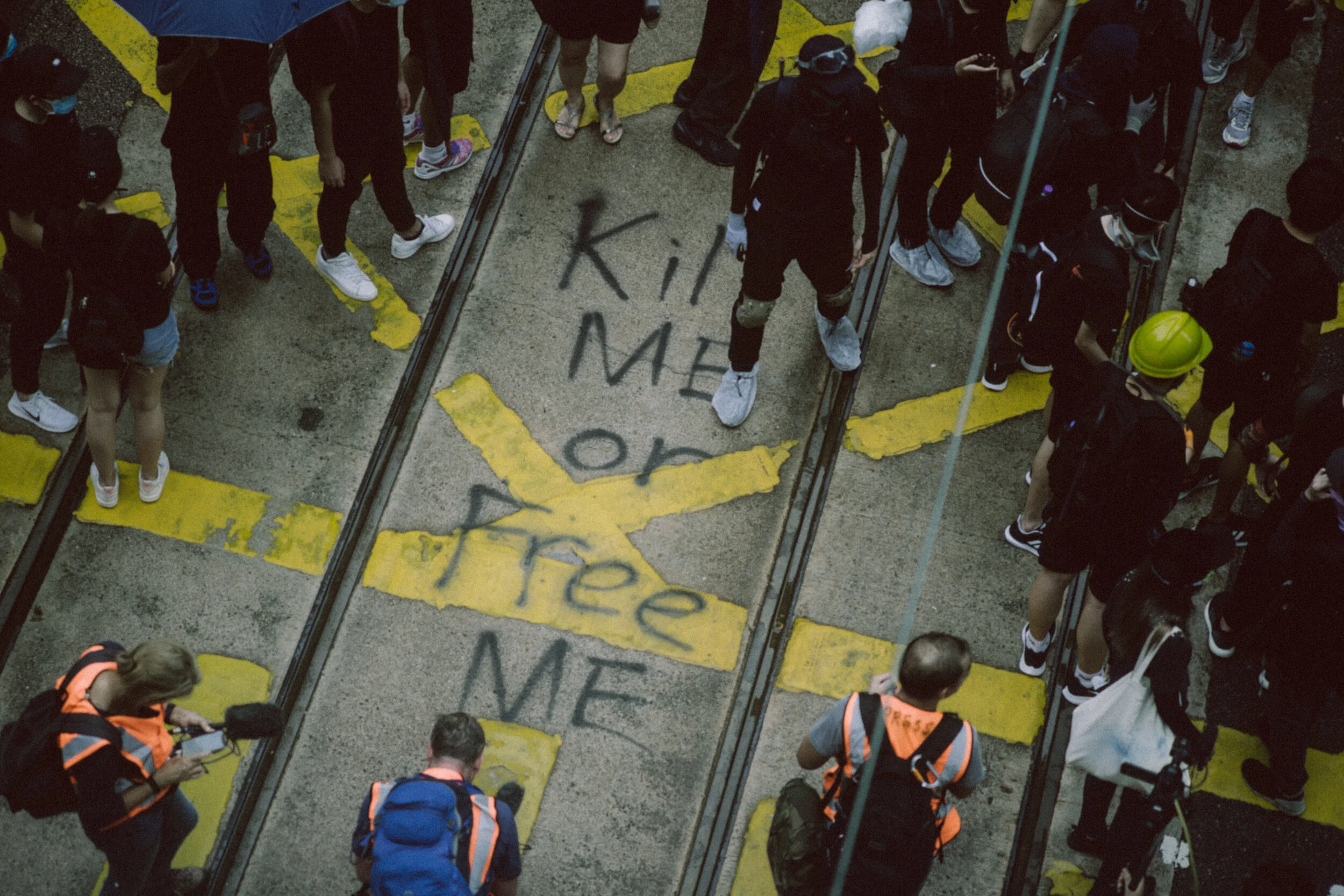
Agnes Chow from Hong Kong, an activist for political reform and youth policy, and a prominent figure in movements from 2012 till 2019 fought for repressive education, electoral reforms and the protests against the anti-extradition bill - till her arrest in August 2019. With the example of the Hong Kong female protesters challenging the “pampered" stereotype of young ‘Kong girls, these movements led by women who are facing imprisonment to brutal regime attacks - have changed the entire narrative around the image of women - who are generally not expected to face the forces head-on. Even if women are not always the majority in these movements, they are taking brave actions, in spite of risks like sexual violence. 'So Many Women Are Standing on The Front Line' as quoted by anti-extradition activist Xiu Lam, who herself fought against her family, like many others for the love of the city and for democracy.  

All of these stories resonate one thing in common: not just few women leaders, but ‘everyday women’ are ready to fight today against the regimes - for protecting their city, for protecting everyone’s rights in their country, for protecting their homes - even if it comes at a cost of losing their own families or lives. These are the new women - who are ready to give away everything - for a better future, for a better home. Are we ready to live up to them? 

From

Images are from unsplash.com

Capitalism, fueling innovations for few: What next?

Getting directly the point: Should capitalism exist or not for the welfare of the world? So first of all what is welfare? In simple terms, it is the well being of people and thus implies harmony, peace and meeting the basic demands of people. Beyond this, it is extended to prosperity and growth of humanity i.e. towards overall development of humankind. For practical purposes, it is broken down into social and economic welfare. The economic welfare is basically "utility gained through the achievement of material goods and services".

In simple words, it is the wealth (mostly, monetary/ assets) which people own. Social welfare can be called the subset of economic welfare or vice versa, but basically, it deals with the well being of the entire society - harmony, no poverty, education, good health, etc.

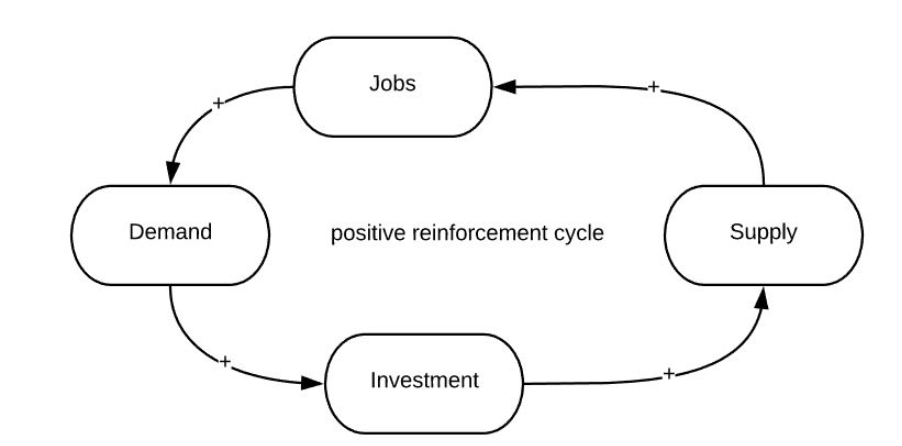
By the definition of capitalism which is "an economic and political system in which a country's trade and industry are controlled by private owners for profit, rather than by the state," it is designed to develop the economy. So how does it do it? Basically, the industries produce products, and the consumers buy. The profits that the industries make are used as an investment, help the growth of the industries again by increasing the jobs and the demands.

Capitalism can help economy run with investments

Now, this looks like a simple easy thing when there is only one company in the market and it is only creating jobs and demands. But this is far from real. So what happens in the real world is there are multiple companies. Some of them become high in demand and this keeps their investment going, increasing the supply and giving more jobs. Some of them have no demand and the investment in them falls, reducing their supply, cutting off the jobs.

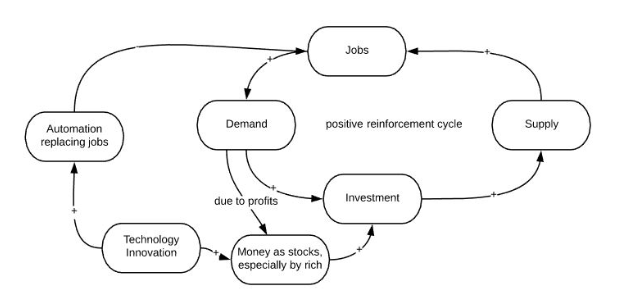
Also, with technological innovation, many jobs have been replaced with automation and the supply is still there and so is the demand. This has allowed ongoing investment, but no need to invest in jobs (as compared to more jobs without automation) or employee welfare. Also, due to digital supply has lead to a decrease in the material supply - there is basically not enough work for jobs anyways. Now, this is leading to accumulation of wealth in hands of those who own these investments. And this is where the problem starts - let me break it down.

Effect of technological innovation

This video by Yanis Varoufakis, explains some of the effects capitalism has on the economy. So let me summarise them for you.

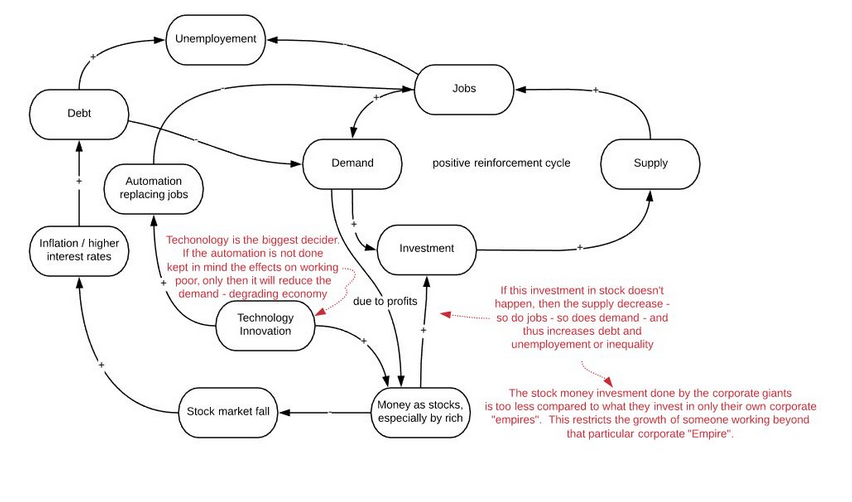
  • There is an idle amount of wealth or rather a mountain of wealth lying with the rich. This can be used for helping remove the mountain of debts, but capitalism does not allow that as it is held by wealthy few for themselves or only their own company and not the economy. Basically, the maximum money of the rich goes for their own company rather than stocks which can go back to the economy. In 2016, 5.1 trillion dollars of wealth was lying idle in the west when there were around 3.4 trillion dollars of investments in welfare like infrastructure, education etc. This is that amount of idle wealth especially with the richest. In fact, this mountain of the wealth of rich just grows inflation of the stock market and raising the prices of the property. This also leads to stagnant wages, unemployment, and low aggregate demand. It leads to uncontrolled reinforcing-cycle of reducing demand and increasing unemployment. [caption id="attachment_1035" align="aligncenter" width="976"] The problems with capitalism[/caption]

  • We have stopped including the economic sphere as part of democracy and limited democracy only to the political sphere. "Capitalism has led to economic sphere colonizing the political sphere eating into its power. Why has politics degenerated? One can be in government today but not in power - because power has migrated to economics. " The most beautiful (because it is so real) and a tragic line I have heard: "the economic as a predator is colonizing the politics which it preys on to such a large extent that it is leading to its own starvation: the economic crisis."

Then how can capitalism work?

  • Capitalism has the solution of replacing the poorest with robots, or rather eliminate the poorest. Technological innovation is only making the rich richer and they are not investing and at the same time, these innovations are making poor lose their jobs, reducing effective aggregate demand. Thus, the automation consequences should be kept in the account as the effect on jobs.

  • Industries need to invest back in the welfare i.e. the economy to keep the economy investment based returns cycle moving.

The fixes to capitalism

Other systemic or more ideal solutions except capitalism to save democracy or basically the rights of people and maintain welfare in the community.

  • Allow the people working only to use the money that they create. This will mean - no more wage labor. No more separation between those who earn and those who work for the company. No gap between capital and labor. No gap between investment and saving.

  • Unified currency "cosmos" - Use the trade surplus proportionate "cosmos" to give back to the green technologies or pressing funds e.g. in the countries lacking behind due to lack of supply and production. Basically, follow what Keynes said!

There are some utopian solutions, and then there are some practical fixes - we can choose whichever way. But we have to choose a way to save the existing capitalist economy which will always favor a few till it favors no one.


Political thinking as philosophy

In policy making, it is encouraged to debate around policy designs and policy impacts. But the perspective we lack is on the policy and political thinking. Let me get to this with an example. Policies are designed to answer a solution to a complex problem. For example, a dam is a good solution to solve water problems, but it also displaces a community. So this demands a policy solution. This starts with (1) understanding such dilemma, and (2) analyzing the solutions.

Now the policy thinking comes before these two steps as a zeroth step. It aims at questioning (1) are policies which we are proposing have only a biased viewpoint? or (2) are the policies just for everyone, or rather, is it even possible to have just set of policies for infrastructural projects? and so on.

This type of thinking is already considered in political philosophical discussions. Political philosophy asks questions like do the government we have makes any sense or is it just there because some dudes told us so in the history. Political philosophy questions the justice, authority, law. These topics originated for politics, but they cannot be limited to politics in today's world. Let me explain the reason below.

The idea of the political philosophy came at the first place to have a just, ethical system in place. This would help more ideas and voices to prosper. And when these ideas gained special momentum till Rawls (by 1980s), technology was not the major player in the world. The technologies today impact everything in our daily life and our political systems. Even leaders are being designed and developed by these technological systems in place. Our daily life to the climate is dependent on the performance of the economy. This, in turn, is controlled by the government and industries, together.

So the discussions of justice are no more limited to that central or any given authority e.g. a government. There are multiple organizations from industry or governments which need justice system to be in place. For example, twitter abusing demands justice. The community whose land is going to be submerged under water because of dam demands justice. So does the minorities in India.

So how can this be implemented? Do we ask every organization in the world to have a philosophers' board or a CEO - a Chief Ethics Officer? Maybe. Install an education system with philosophy in mind, or finance philosophy schools more? Meh. That is again an organizational solution. Which makes it longer to implement.

There is a much easier and a practical solution - make everyone a philosopher. Don't look at me like that, I am not kidding or making everyone The Thinker by Rodin. I say it is an easier solution, especially in today's world. It is so because we have a voice today due to platforms like Twitter or sometimes, Facebook.

Basically. We are more powerful as an individual we ever were in the history of humankind. This means that my life is equal and as important as the life of any monetary rich soul on earth. But you are important, and the power is more decentralized i.e. you also have power. So does your neighbor. And so does the national government.

Coming back to the solution that everyone has to be a philosopher. It means that now that we have a voice, we cannot act ignorant or just a part of masses. We have to ask, question and wonder about why the systems we are a part of - are made like this, at the first place. We need more open discussions about each of technical, social, political, industrial system. Systems like Reddit and Twitter have enabled us. They allow us to give more policy solutions. Also, we can raise opinions over why some policy solutions suck.

But we are not going to the zeroth step i.e. asking are these policies actually the only way to look at the system? Can't we have something simpler, or even more complex? We need to ask the why of why - or go to the impact of impact. We need to maintain that legacy of humans by doing what humans are best at - think! Technology has given us a strong identity: as the humanity and also as an individual. We are more important as an individual in today's world. Thus, we need to be more responsible as well and think before acting.

The blackhole called education-loans

I am not at all against the system of loans, but there are reasons I hate education loans. Let's break these reasons down. Talking in terms of values, education loan should help people gain knowledge based on which they can get jobs to pay off the loan. Knowledge is gained not just with the classes but with the life the student has around the school. But due to the constraints and burden of the loan, most of the students stop having a life outside or around schools.

This ensures student to have a good record on the transcript (as their weekends = libraries), but this also stops the growth of a person beyond their school. But assuming this still helps a student get a good job, the student has always lived in the pressure to finish the degree not for learning, but for the tuition fees. Leaving him/her no time/chance of reflection.

In terms of economy and claims that tutions fee help schools survive, as Noam Chomsky breaks it down very beautifully here, the education loans have originated due to a simple reason of efficiency of schools - and profits in hands of few. The tuition fees were low in past even in USA or Netherlands and are low/ negligible in countries like Switzerland, Germany, and Finland with great education system intact. So, it is completely not a case that without tuition fees a student cannot get the quality education. So fundamentally this system is meant for filling pockets of few, and creating vicious cycles of debt for those who have taken loans.

It saddens me looking at countries like the Netherlands has had so great education system and now they are increasing their tuition fee every year and being just one of the many rats in the race. These places have forgotten the meaning of university as Chomsky puts it "Universities ought to be the place where as many people as possible...have the opportunity to develop their creative capacities, their independence, their joy of discovery, their ability to work with each other to achieve desirable social ends that they can figure out. When students are in a university they are really at the freest time of their lives. They are out of parental control. They don’t yet have to devote themselves to putting bread on the table. A lot of freedom and opportunity — and that’s the point of a university. "

What is the solution? Maybe better state funds, easier loans, better stipends for students. At least there needs to be a discussion or a debate by students and equally professors to show a willingness to change this system.

Health insurance for India?

In India, basic health care needs are also hard to be accessed by the citizens in some regions. Moreover, rural areas in India face a shortage of more than 12,300 specialist doctors. There are vacancies for 3,880 doctors in the rural health care system along with the need for an astounding 9,814 health centers.

In my Masters in Policy analysis at TU Delft, with my colleagues, I worked on a cross-cultural study to understand if the best systems (UK and Netherlands) for healthcare insurance policies fit for India. Results: Such transfer of policies looked impossible as-is they are in India, i.e. if the policies are copied exactly from the UK or the Netherlands. It needs a lot of other policies in place first, and we try to look into such policies.

(Why) Do we need compulsory healthcare insurance for all?

We need it. Why? Statistics of our health are getting better, but inequality of its access is getting worse. An equitable distribution helps contribute to the health of a nation. Cross-subsidy system makes sure everyone get access to good health facilities.

Is it possible to make this equitable distribution considering the population and economic disparity we have? It is difficult, but not impossible if the economic levels are considered to define the type and applicability of insurance schemes. It should be noted that this is not a one time job to implement such nation-wide policy, but it is an iterative process.

How was this study carried out?

Comparative analysis between healthcare systems in Netherlands and the UK is done to chose the donor country. These two countries were announced as the countries with the best healthcare system in the world. 

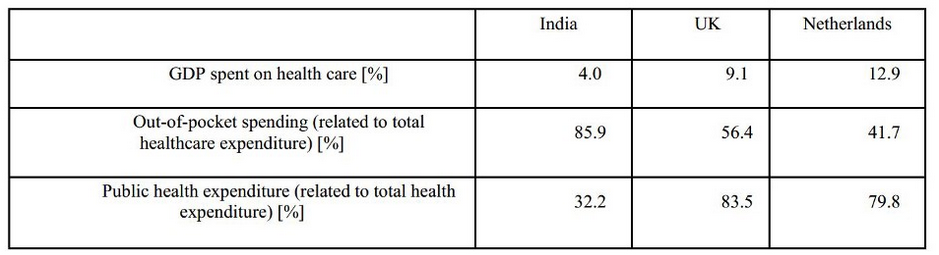
Comparison Between India, UK And Netherlands Health Care Financing System

Hofstede’s six cultural dimensions helps describe the effect of the culture of a community on their behavior and values. These dimensions were studied for UK and India (with family of nations perspective) and its implications/ feasibility on transplantation of healthcare financing policies was analysed. 

Hofstede’s 6 Cultural Dimensions Comparison between India and United Kingdom show India and UK to have very different types of culture.

What can be the next steps?

  1. People: Awareness about its need among people. People would feel this system as sucking money out of them for no reason (even when I am not ill, why I am obliged to pay?). But if they understand they are investing for their future, it is easier to convince a majority of people. Also if everyone understands the biggest picture, i.e. equality for health, you have convinced a major of the remaining crowd. Above all, this can be implemented in stages:

  • Make people aware about importance of health-care facilities

  • Charge less money as taxation which includes basic vaccination

  • Full provision of facilities by the government by involving an organisation like IMF, World Bank.

  1. Government: A good collaboration between the local and central government is key to its success. Inefficiencies and corruption of middlemen delays the process. Direct implementation by central will make people feel forced by this policy and implementation by local government will introduce inefficiencies. So, the way out: Slow and steady process by local governments, which:

  • starts with a collection of local level population data (urban can be targeted first due to better awareness),

  • launching awareness schemes, and

  • then strict implementation by central policies

  • roles for governance should be divided in phases and should not be overlapping. Overlap would lead to higher inefficiencies and corruption than hand-overs.

  1. Arranging funds: India won't be able to pull this itself. It would need either international organizations or direct support from countries with such established systems. In 2012, India was able to completely eliminate polio with the help of WHO, which proves example of benefits of outside force

  2. Private companies: Co-payment system as established by the UK is a good example for sustaining the system with the private hospitals and insurance companies.

What measures ensure the success of such transfer of policies?

To make the transfer of policies from one culture to another possible, the new culture should have high practicality and high desirability for these policies and its implementation. This will be a highly acceptable transfer for the stakeholders in India, if the following conditions are fulfilled:

  1. The debt from IMF is paid o on time by an increased healthy working population

  2. The taxation is considerate of the incomes of people below poverty line and the system of free health care facilities for them continues.

  3. There is no or under-control level of corruption in the proposed system

What will be the results?

  1. More personal responsibility towards our own health.

  2. Equality for health facilities access for all.

The complete extensive study as published can be found here. This study is included as a chapter in India’s service sector: Emerging perspectives, edited by Kawal Gill, K.V. Bhanu Murthy and published by M/S Athena Academic.