Cozy winters of January 25

India – a blend, that’s what it feels like. Not a hotpot, too messy for that; not an amalgamation, too fancy. Just a blend of everything – emotions, colors, flavors, sounds, and lives. Human and non-human. Stray and free. It’s like stepping into a living, breathing canvas that changes with every step.

This time, though, it felt warmer.  Not in temperature, but in spirit. I met people whose hearts were full,  whose kindness was genuine, whose souls were nourishing. And in that  warmth, I found something that renewed my hope. Yes, the politics of the  country wear you down, the cruelty of capitalism stings – I know my  privilege, and how it shields me, though it doesn’t change the truth.  But despite all that, the people – yes, it sounds like a Bollywood line,  but doesn't Bollywood reflect the spirit of the people (or at least it  used to?) – the people, with their ever-giving outstretched hands and  open hearts, reminded me that hope is alive.

So, here it is, a  tribute to them, based on a travel story in the mild winter of December  of 2025. To the ones who make it all worthwhile:
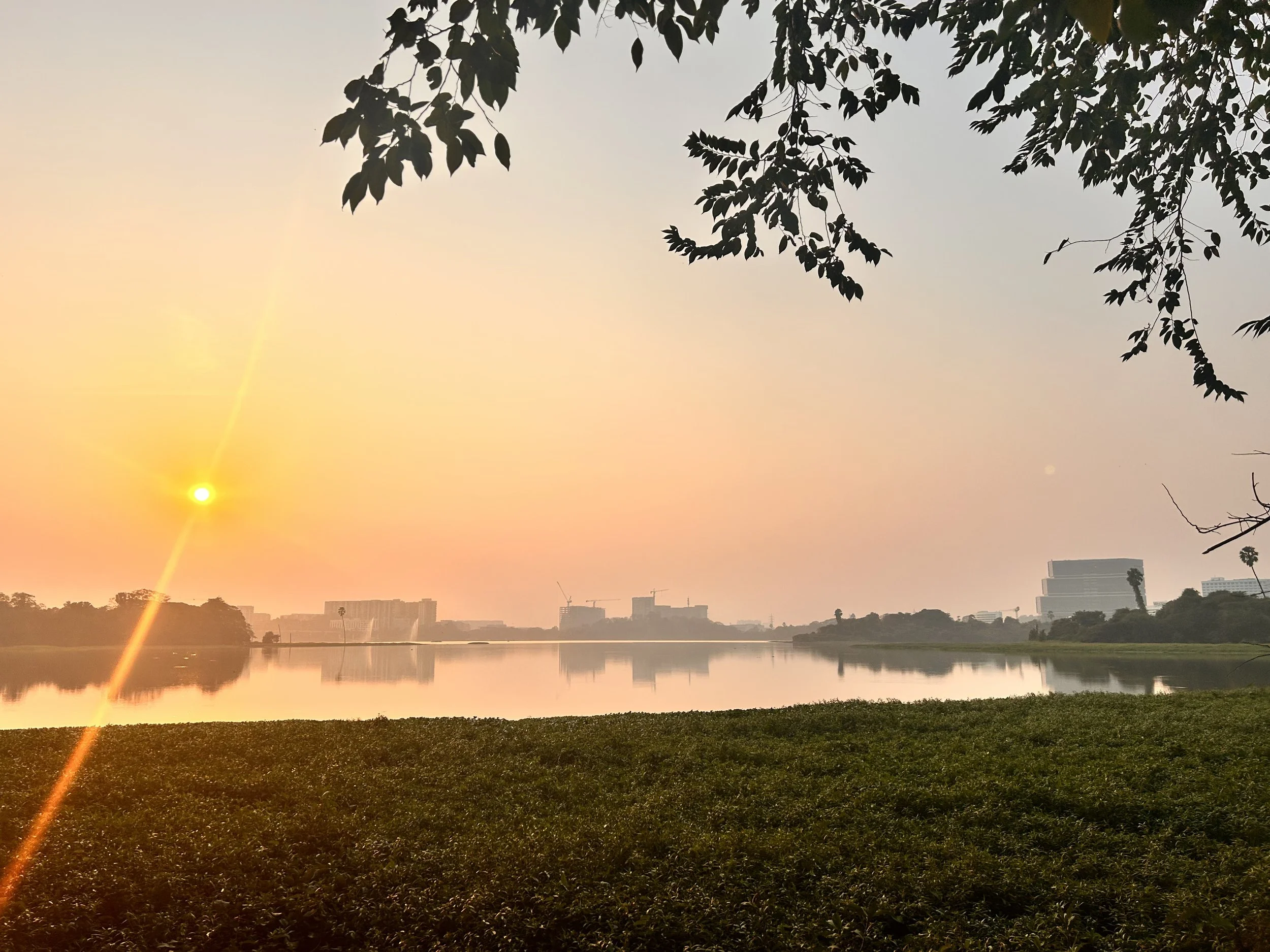
I might have heard those waves hit

the Mumbai Bandstand for the 156th time, 

But it still feels just the right amount of fine.

The right amount of calm, warm, 

And cheeks kissed by the settling breeze of dawn.

There’s a dull ache of pain, 

From the hands of goons at gain,  

In the same city I can’t overlook,  

From the smog of its sins.

But here, I take the pleasure of all the pain,  

Cursing capitalism from my air-conditioned 19th-floor gain.


So I move… move to the slowest city in the world, as they say...  Bangalore.

Slow traffic, slow life to embrace all those gains.

A city of startups and slow-paced days

Of tech dreams and old-school ways.

Where rain falls softly, the skies are blue and gray,

But somehow, it still feels like a lost and found home, someway.

A short stop on the way, I meet Kochi,

Clearly a well versed global, liberal and secular friend.

Filled with immense natural beauty and heritage,

Hosting history from distant shores - a blend.


In Mattancherry, the past lingers on, 

Woven together in a vibrant song.

Jews trading spices, their stories unfold, 

Followed by Parsis, Christians, and Muslims bold. 

Hindus, with their temples, leaving their mark, 

Once separate, now entwined in the dark. 

A blend of faiths, time’s hand refined, 

Creating a history that’s both yours and mine.


Thrissur and Guruvayur, the heart of celebration, 

Where mighty elephants serve in divine devotion. 

Are they gods themselves, in grandeur so bold, 

Or sacred beasts, in stories retold?

Decorated in splendor, like the temple aglow, 

A thousand lights sparkle, as the spirits flow. 

Here, the temple isn’t just stone or clay, 

It becomes the life, the pulse of the day.

No matter your belief, you stand in awe, 

Witnessing a miracle, a divine law.


Last stop of Hyderabad, a city so grand, 

Where biryani’s aroma fills the land. 

The Charminar watches as centuries blend, 

In markets where cultures and colors transcend.

Lanes of bangles that shimmer and shine,

Stories of faith in every design. 

A breeze through the bazaar, memories arrange,

Of home, of unity, of a hopeful change.


- Rhythima

A humble resident of many of these homes
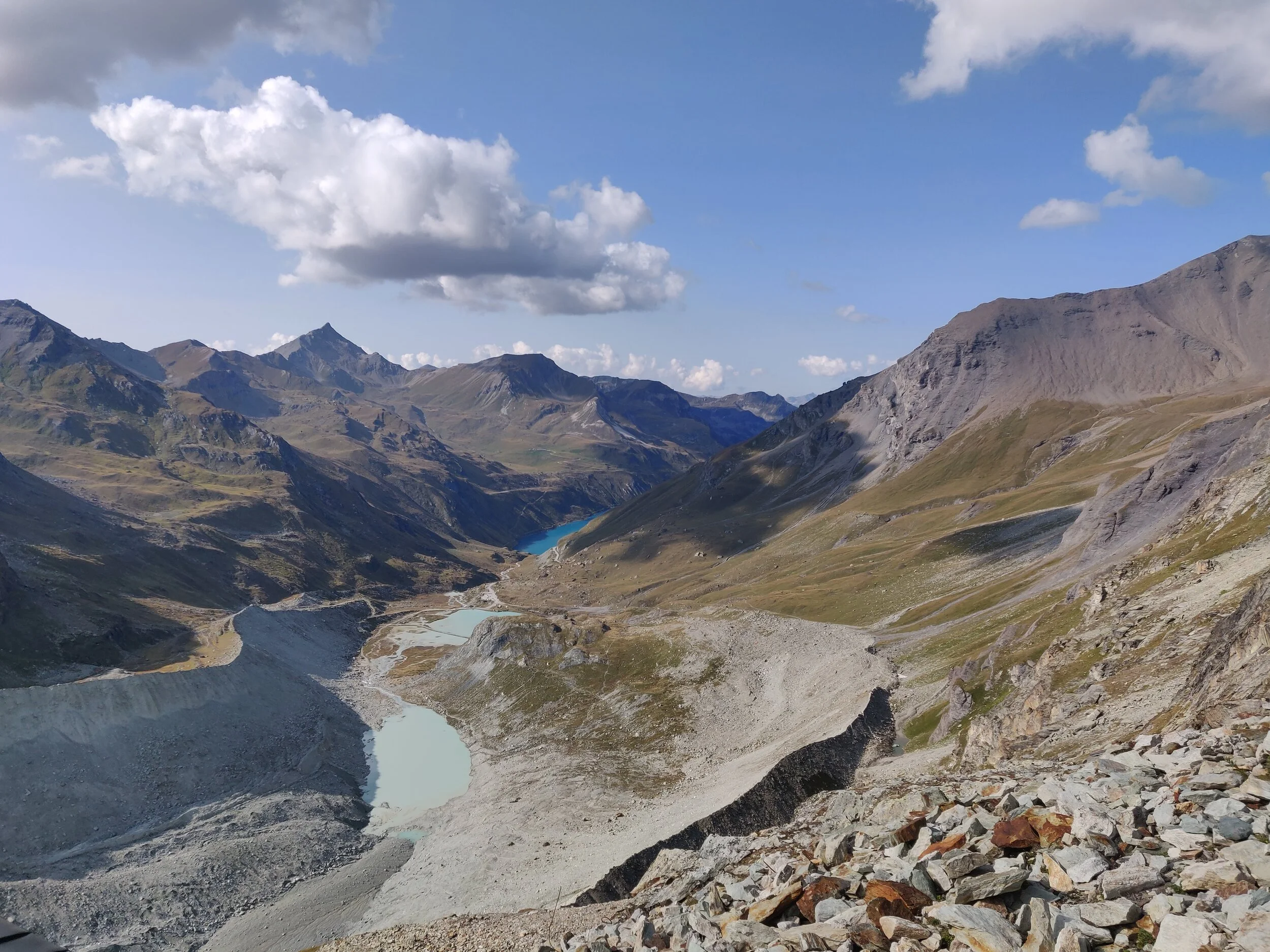


A walk into unknowns

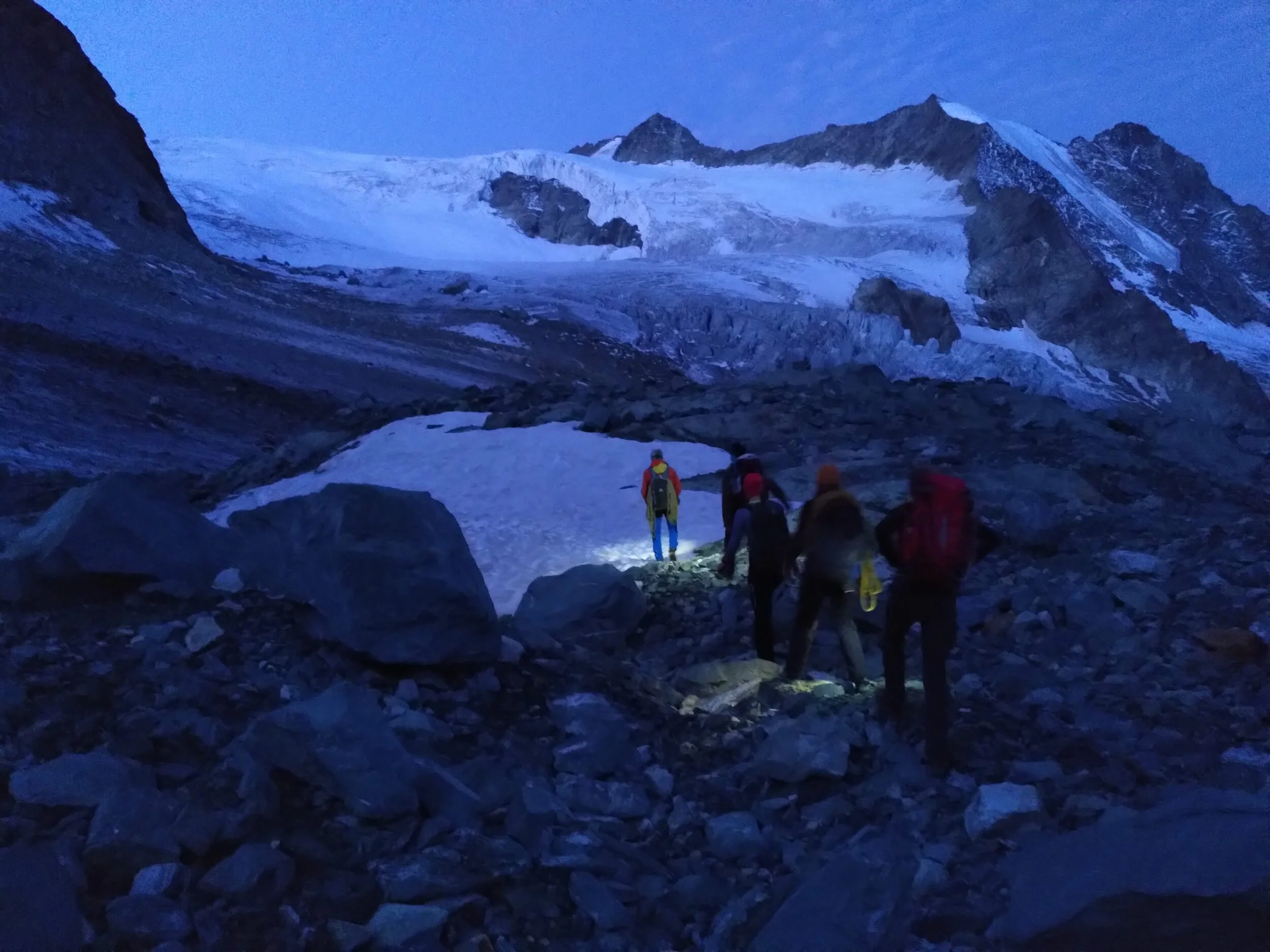
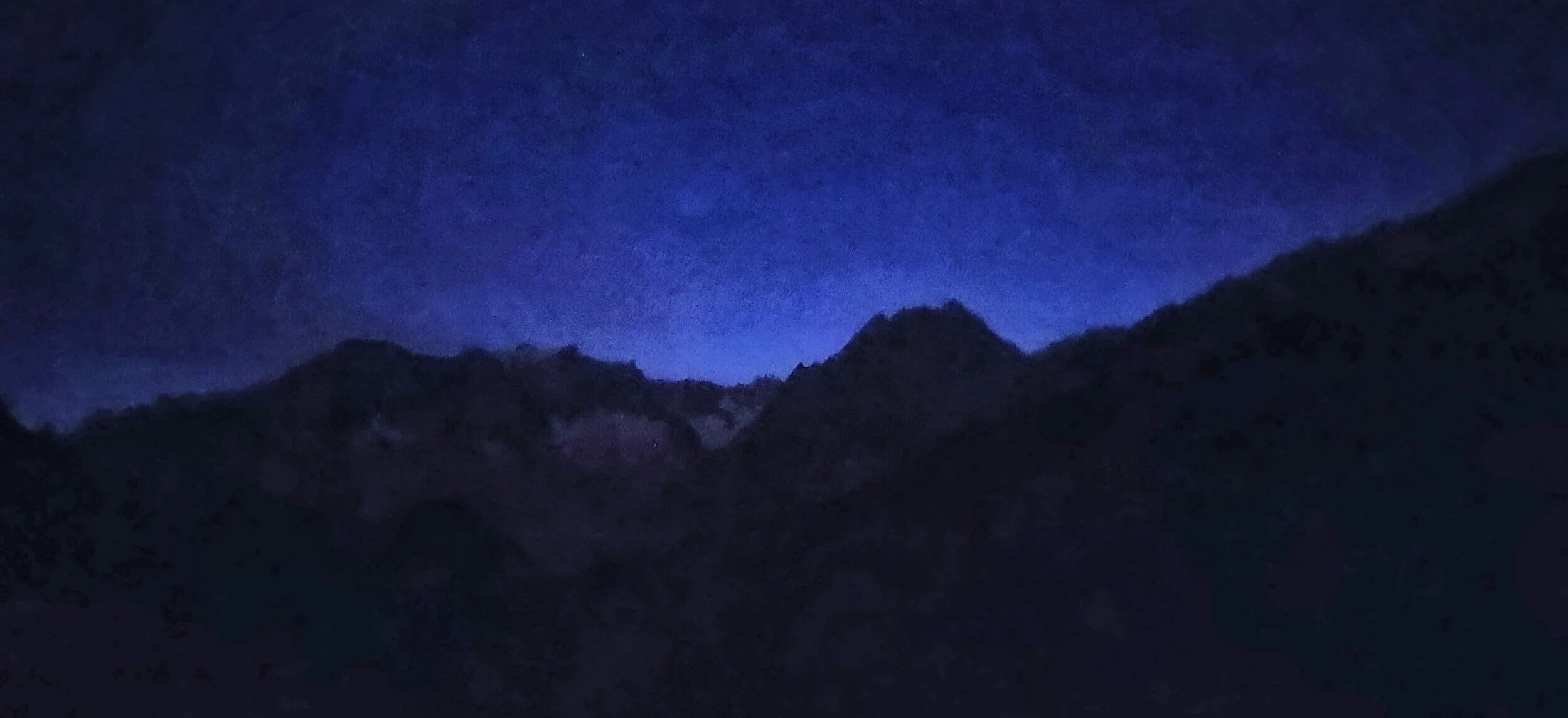
15th September 2020, 7 of us woke up at 4.45 am, got ready, had a quite breakfast and assembled ourselves at 5.45 am with our crampons, ice axes, dry-fruits pack, and back-up layers of clothes if we start freezing at the top. The aim of 3600 m to Pointes de Mourti, was a small feat for many in the group, especially our guide who has summited Himalayas to Alps. Personally, I was aware it was going to be challenging as my first 10-hr journey of glacier-hike, climbing, and ridge-walk to summit, partially in night. No doubt, it was going to push me mentally and physically.

A day before, we had walked up and down, around 570m, till Cabane-de-Moiry (the only mountain hut around Moiry Glacier) from the turquoise glacier lake with some ridge walks up and down, and a practice glacier walk. Later at dinner, we realized how exhausted we were already due to the weights we were carrying. While having a warm vegan chocolate milk, I still could not stop feeling the amount of privilege I had to be there, and to take up this adventure.

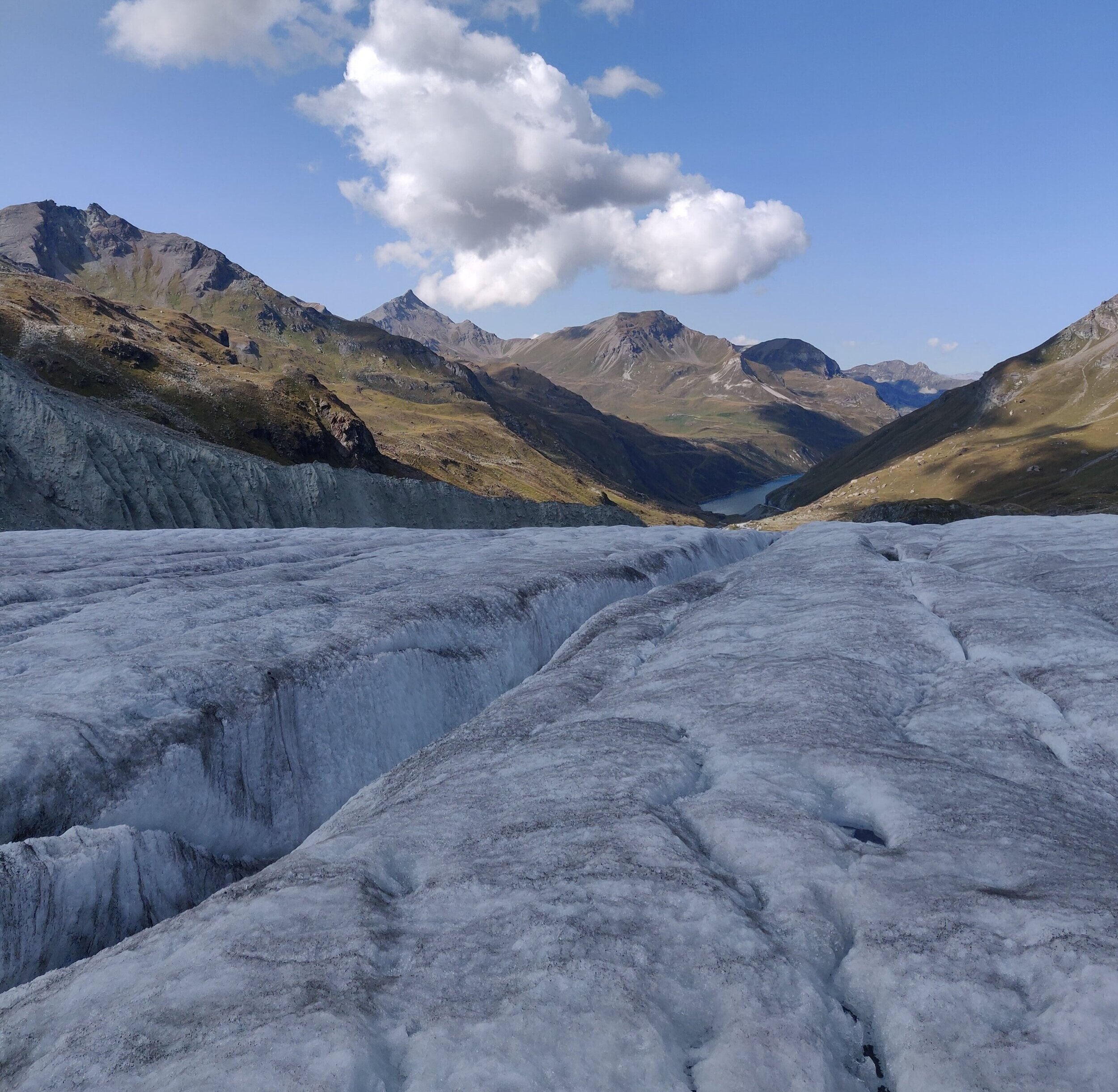
The first hike up with the barely visible white-blue-white marks, till the point to reach glacier, was not very hard as we were pumped up with nice breakfast and 6 hr sleep in cozy sleeping bags. Then as we started slipping slightly on the icy rocks, which were shining like diamonds in the first rays of sunlight, our guide asked us to take out crampons and put them to continue our walk on the start of glacier ice. Safety first: we also put out our harnesses before the crampons, and tied ourselves with ropes with a minimum distance of 20 m between each. The idea was if one falls, other too. No, kidding. The idea was if one falls in a glacier gap (called as crevasse); at least the other could help by balancing the fall by securing the two with an ice screw. The ice started getting thicker and crevasses were visible – in all shapes, depths possible. The logic was simple – avoid the crevasses, walk on ice. Simple.

IMG_20200913_151516.jpg

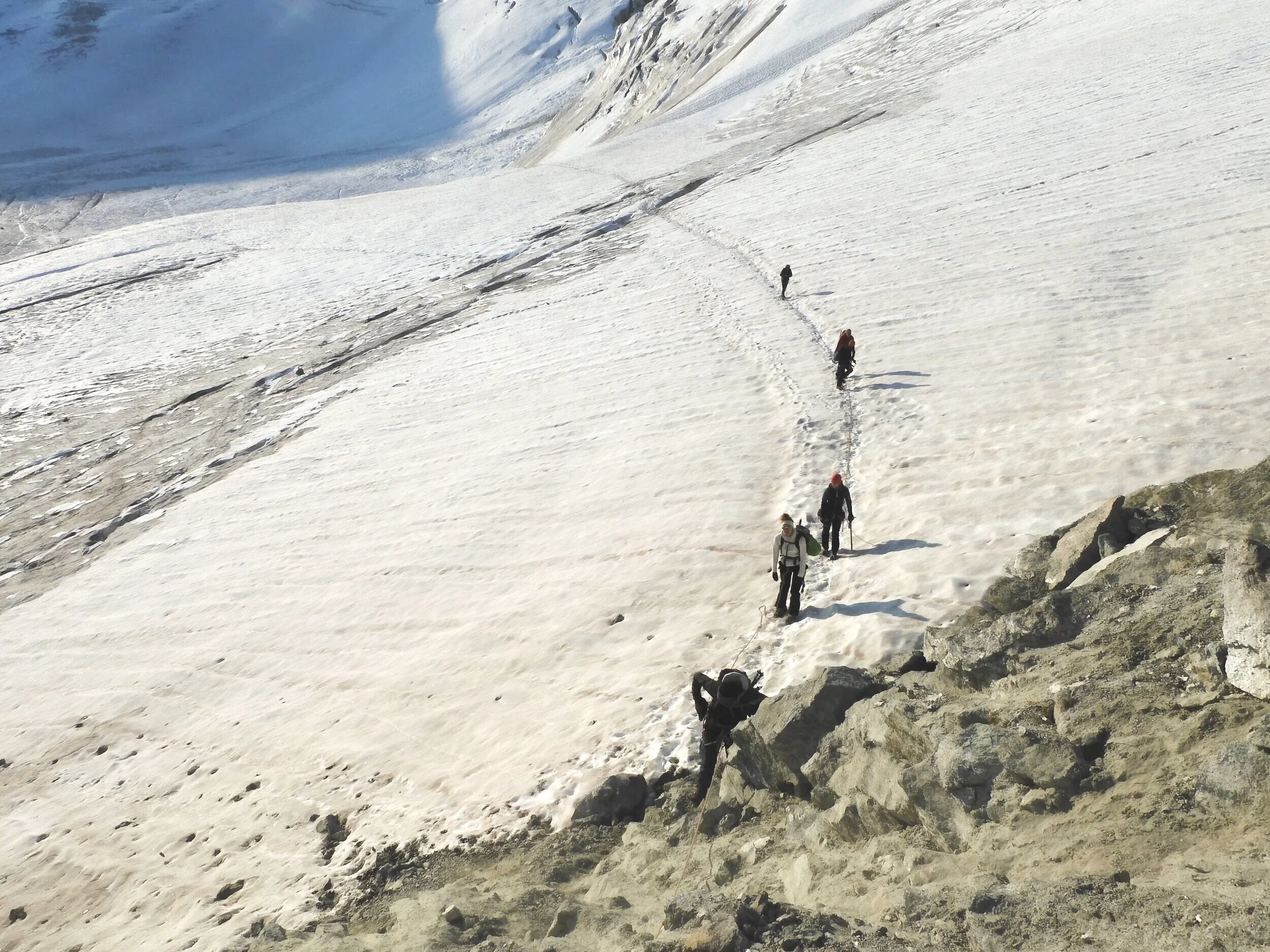
Slowly, the geography started changing further, as the crevasses and the ice got a layer of snow on it. Now the trick was to know if there was snow covering some crevasses. We never know – some in the group said you could always insert your ice axe to gauge the depth – but the risk seemed low to try this. As we started climbing up on the snowy glacier, the sun on our backs started rising, and it was one of the most beautiful things to witness.  The entire pass started glowing and we reached flat snow to wear our sunglasses. After walking some more on the snowy edges, we reached the point where my heart started pumping out of my chest. I could see the rocky ridge we aimed to climb and it did not look any easier than what it looked from the hut. We all took out our crampons, but left the ropes and harnesses on us, because the real risk was actually starting now. I decided not to look down until we reach the top, because I did not want the fear to win. As we crossed a small walk up to the ridge, I started feeling my shaky legs and the fear completely grabbing me. After letting down maybe one or two tears of fear, I decided to stand up and do this. And, so we were on.

IMG_20200914_063614.jpg

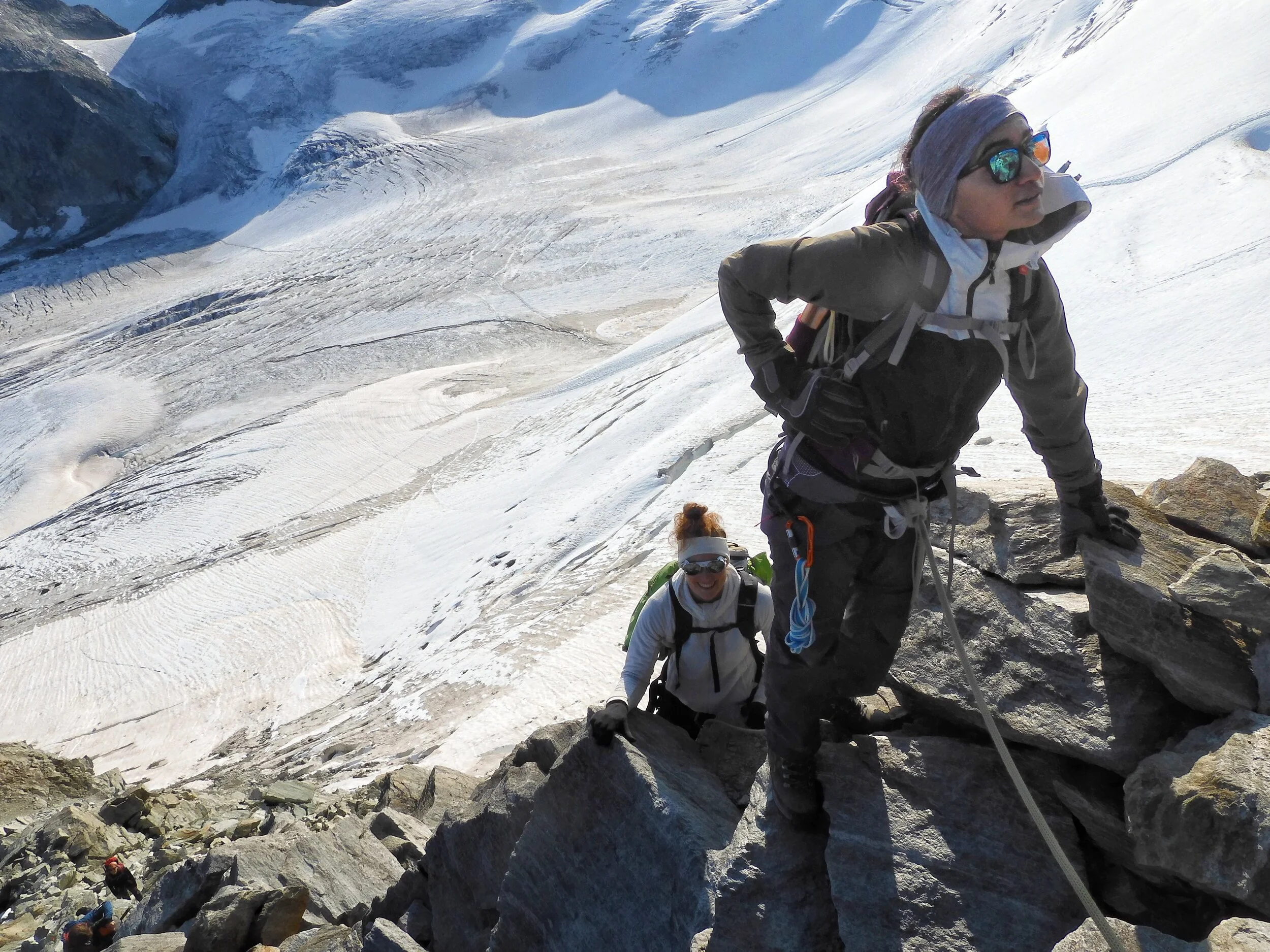
The ridge walk was ‘safe’ with not a very narrow ridge, but it was very tricky at times for absolute beginners. I had walked on narrow ridges before – but those were well-crafted paths. This one was not a path, we had to choose and define a path here. As I was one of the least experienced person, I got to be the first person behind the guide, and his instructions made it easier for me to start trusting the small slanted rocks to climb up. And this needed energy - and some good fitness. I knew I was not in my best shape, but I trusted myself a little bit there. As one of my friends (and colleague) mentioned, “Trust the Swiss mountains, Rhythima” – I had to slowly start doing that too – and trust those small cracks in the rock to step up.  We came across a small climbing part – and I went in my head “okay guys, I did not sign up for this” – but to be honest, it was not very hard after I started trusting the rocks more. The climb took the longest time, and soon we met a small snow part to be hiked up to reach the top. This was steeper and edgy, but we had ice axe, and crampons again and there was a good path, which mountaineers from last days left. So, we were good to go.

DSCN1902.jpg

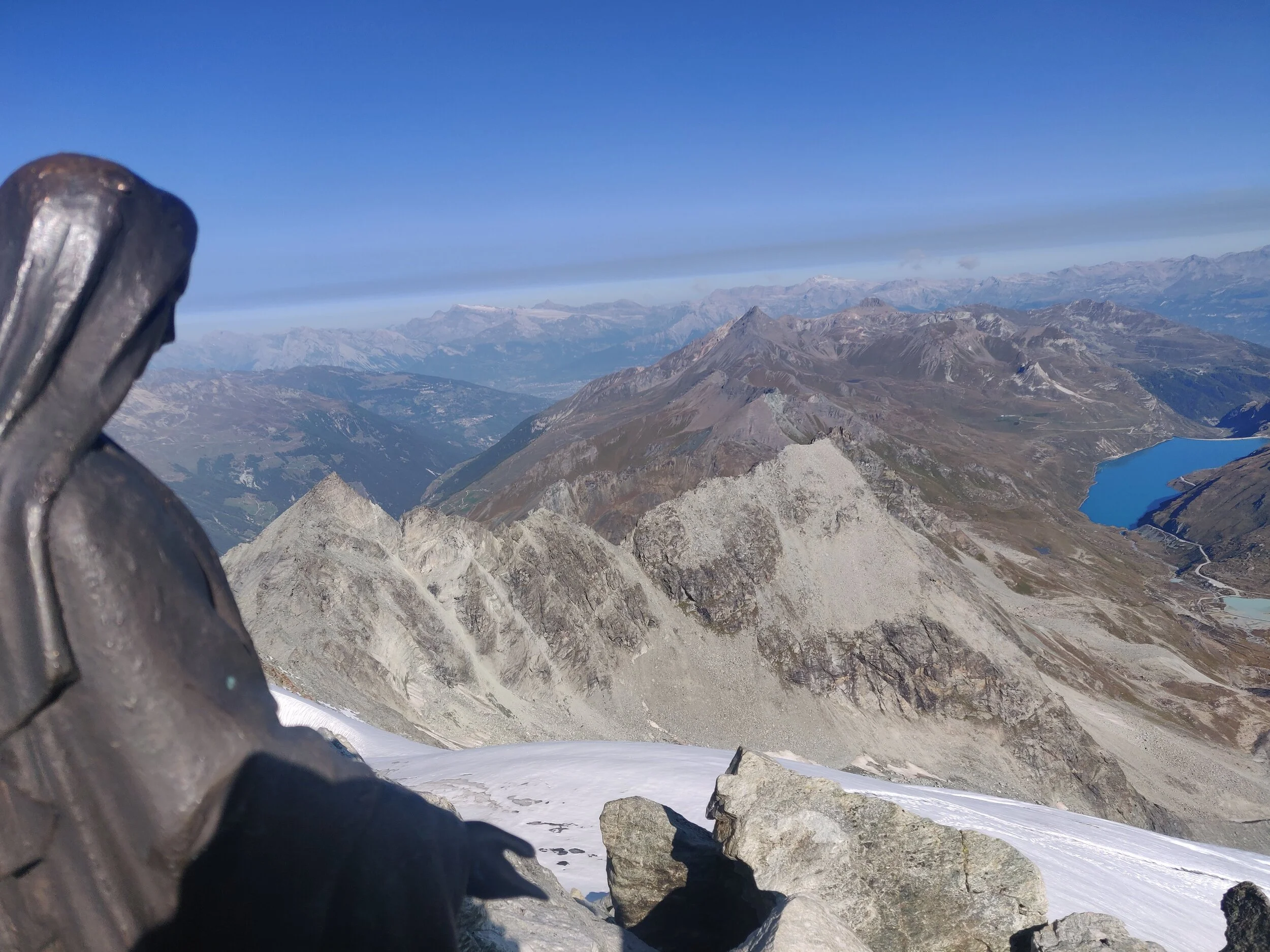
After crossing the snow, and climbing some more rocks, we were at the top. Just like that. I thought to myself “this is it?” In that specific moment, I felt like there had to be something more – maybe a new feeling - to reach here. Then quickly I recalled all the struggles and the doubts I had for 2 days and what I was looking for was a feeling of contempt - satisfaction, maybe.  In the uncomfortable position on that rock (mentally and physically) I was sitting in, I took a bite of my sandwich and started looking in all directions, and there was too much to feel, but nothing specific was striking enough. We could see - the highest mountain of Alps: Mont Blanc, there was beauty of Jungfrau top, there was Lake of Moiry glacier, and the small little hut we started from. But the only next thought which came in my mind was “okay, how do we get down now?” The summit was not at all how I imagined it. I was expecting too much, and I felt too much – but both were different - what i was feeling was not expected, and expectations were not met. I looked at others, and wondered if they were going through the same, or just simply enjoying the summit.

And then, suddenly, there it was: The summit is glorified as a victory due to your past struggles, or it is glorified as a stepping-stone to your next big adventure – something that qualifies you to take the next step in future. But nobody talks about summit the way it is. It is a simple moment. Like any other moment, just another moment. It need not be defined based on the climbs of the past, or the falls of the future. It need not be a competition or comparison with others who are around you. Even a summit, a destination, like the journey itself, is about living that moment. Being grateful, and moving ahead. It needs to be simple. It is simple.

IMG_20200914_102207.jpg

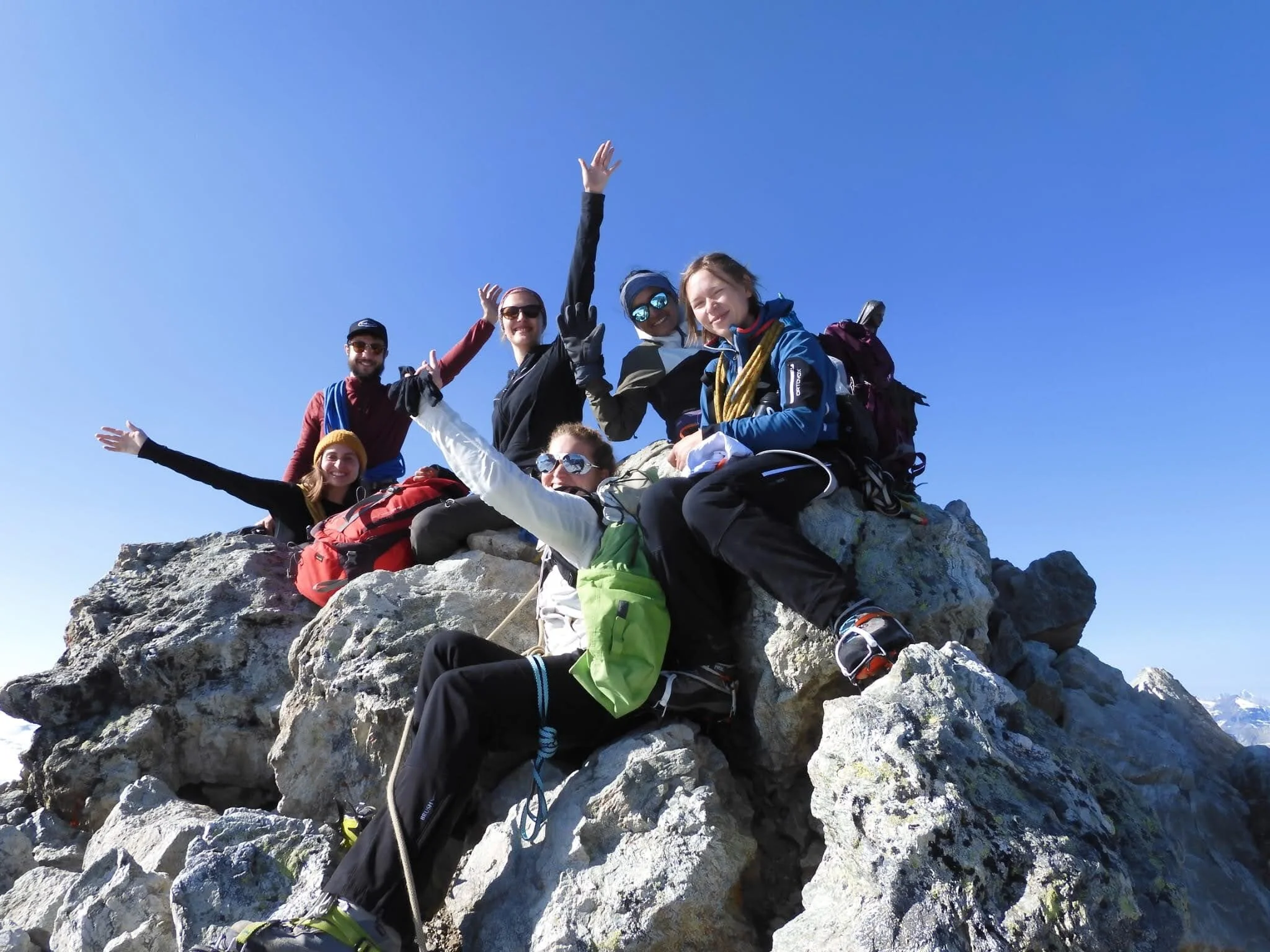
I had 3 more bites from the sandwich, and after a customary summit photo, we were ready to leave for the down-climb-walk. Now we were going down in an exact reverse order with the mountain guide at the end of us all. I started feeling much more confident- and started to walk down straight, rather than being on all my fours. Everyone said we did it much faster than expected, and I was glad to be down soon on the glacier again. After slipping once or twice in the snow (probably in small crevasse openings – though the guide seemed super chill about it – as we were tied up and it was probably nothing much), I decided to start concentrating better to walk on the glacier. Slowly I started realizing my migraines might have been building up, and my body started feeling extremely tired, we were walking for almost 7 hours. And I had also used a lot of my upper body strength, which is unusual for me in hiking. So as we reached at the end of the glacier, I took my imitrex (migraine medication) – biggest rookie mistake ever. Imitrex has side effect of impairing your focus, and obviously, I was doomed for the next patch of rocky walk down. This was supposed to be the same path, which we walked up quite fast in the dark at night, but now every step felt like a huge effort. After a lot of personal effort, in spite of it being one of the clearest path, we reached the hut again in more than longer anticipated time. And the only thing I could think of was a sugar filled coffee and big piece of cake. And yes, I was lucky enough to get both. And then we peacefully walked down to the parking spot for another hour and half, to high-five each other, for the completed adventure.

IMG-20200914-WA0028.jpg

It was so interesting to see that each one of us walked the same path – but coming from different countries, backgrounds, different experiences in mountaineering, level of fitness, different attitudes towards life – had completely different set of expectations and experiences from this journey. Our discussions revolved a lot around sustainability, as we all work in the same field, but there were so many different questions on the similar topics, ranging from geology to black-lives-matter. I definitely learnt a lot from all of those who accompanied me on how to be humble, kind, and respect everyone’s limits and choices. This was truly motivating and inspiring. I learnt to expect nothing, strive for best (in your limits), and live what may come. I learnt to balance risk and challenge, with security from our guide: These paths are not doable without mountain guides, so taking one is a very important choice, especially to know the right paths and safe options (in shifting weather conditions at heights).

Above all, I learnt that nature is a crazy beast. It shifts abruptly, it growls, but it nurtures. It is uncertain, but it is growth. So respect it, live it. And do anything and everything to help it keep it the way it is. Ironically, in the end, nature’s vastness does make you realise importance of your own minute significance.

DSCN1906-01.jpeg

Vastness of emotions in sync with vastness of Aletsch

Aletsch glacier, labelled as ‘the greatest glacier of alps’, is actually beyond its brand of greatness – it is literally the largest glacier of the European Alps – source of many rivers feeding to the European continent. Starting from Riederalp, you have a good view of the small villages placed like Lego all over the patches of the greenery of mountains.

The first emotion which strikes you as any other mountain is the scale of the entire landscape which stands in front of you, quite proudly. Personally, it has been very difficult for me to understand that a 3 km, which is 3000 m, is standing vertically in front of you. And then there are these tiny sheep herds grazing on it – quite comfortably, very zen, very chilled. How do you compare these two?

Even before you are over the emotion of this scale paradox, you are thrown with the number of colors – in the vegetation – among the rocks, among the yellow, red, blue hiking marks – among the fluorescent colors of all the hiking boots, coats and fancy sunglasses. The colors come in forms of humans too – some people are extremely happy and having the happiest day because come-on, they are in mountains. Others are just fine, because it’s a daily affair - they were conceived in mountains, for starters. Few are just angry because it’s the uphill or the downhill or they have a lousy hiking partner or only one Mercedes back at their homes, and crying their hearts and sweat out. And yeah, the pissed ones are the most colorful folks.

Aletsch glacier has 27 effing billion tons of ice, and it is 23 km in length. I am going to let you think about these numbers for a while. It has these huge cracks and a gushing river flowing under it, looking at which runs a shiver to your core. But the scale paradox again messes up a bit here, because looking from a height, it looks just like any other snowy-icy patch placed in a valley. Meh. But again, go to the first line of paragraph and read those numbers –“If the Aletsch Glacier were totally melted, it would produce enough water for every person on Earth to have a litre of water per day for 4½ years”. Not meh, eh?

The mountain pass around this huge chunk of ice is quite an exercise on your toes, knees and calves – with changing ascents and descents. The path was insanely pleasant experience irrespective of it though, because it started from beautiful vast stretches of mountain grassland and then ended up in very rocky patches with no scope for a single grass. At the top of our path, there were just rocks placed over one another, mostly formed due to constant snow and ice-based erosion. Basically, a very tall pile of pebbles and small stones also qualify as mountains in these regions.

Now comes an actual emotionally sad part: the glaciers have been melting, surprise surprise – because we are fucking the planet – surprise surprise. And this is not even half of the sad part at all – it is a fact, the sad part is that the mountain hiking passes are slowly closing and even going much away from the glaciers because the mountain is literally cracking up. As the glacier melts or let’s say retreat with a much faster speed than expected, the mountains start shifting downwards with much faster erosion and a loss of foundation ‘land’. This has cracked up the mountains and eaten up the hiking paths completely. This is something we realized when we saw many closed paths. Also, we felt like stuck in matrix - we ended up being 2 hrs from the hut, even after walking an hour from the first post which mentioned we were 2 hrs away from the hut.

The mighty aletsch

The mighty aletsch

Why do I chose to talk about this Aletsch trip specifically when there are even higher peaks I have been to? So this was my first ever hike in mountains which was planned to be longer than a day, including a stay. And what you get to see in this is not just the spatial x-y-z axis of the mountain, but the 4th dimension – changing time (‘t’ axis) in mountains. For us, the view of the glaciers remained quite pleasant and not at all scary – because we remained there in a good amount of daylight. It started becoming quite windy and cold as we approached our first destination at the Marjelensee hut.  By the time we were ready for dinner, the dusk had approached and the darker shades of blue and golden streaks of red were visible. The stars were still shy. By the time we were done with dinner, it was pitch dark and the first thing we noticed as we got out of the hut was the mega(aaa) Ursa Major right over the mountain. We made unsuccessful attempts to find the Orion, but maybe wine had done it’s job and it remained a mystery if Orion was visible in Vallais Alps.

Like my last blog, I am aware I end up talking again a lot on the time-scale revelation which is induced by the nature’s mere presence and its vastness. But there was one more thing which stood out in this trip, which I think remains primarily human (and natural) – the human company you end up being with in this landscape. This time I was able to share my time with a wonderful friend and kudos to her that I ended up having feeling of extreme anger to extreme peace in few minutes – something which might be slightly induced by the tiredness from the hike as well - but mostly because of just an honest company. 

So the biggest realization from this unique hike experience was quite simple, irrespective of where you are at – in mountains hiking, in city driving, in a desert lost (not suggesting), you remain a human at the end of the day – filled with all those experiences and definitely amazing memories, but mostly those emotions which last longer, and your efforts might go in maximizing those which makes you feel most at comfort (or at ‘home’) . But moreover, if we are human enough, it is important that we let everyone have these beautiful experiences – especially our next generations – and that means a ‘sacrifice’ at our own parts to be more responsible. The melting glacier and moving mountains, moved me deeply and made us realize that we are already late for not just this beautiful humanity but the entire nature – so lets take a step back, think and then, (re)start.

An end or a start?

An end or a start?

A hiking beginner’s journal: The space-time revelation

For a year now, I have been addicted. Addicted to hiking different places with varying topography, difficulty, and this made me go over 28 peaks in six different countries in three continents. A very simple motivation for me to hike was to be outdoors more, because for 2.5 years of my masters I was just indoors, with no real communication with humans or nature of any kind. Being in Switzerland led to a relentless study of different Alpine paths, mapping elevation gains to the level of fitness, understanding the layers of clothes essential for different heights, and such trivial tasks which defined whether I was finishing the hike within the last ride back home or not. I remember the first hike I did where I was in a large group and made everyone stop for a mere 200m ascent, and I remember the last where I stopped just once for a 5-minute lunch after 800m ascent. So yes, personally, I have gained a lot from these hikes, in terms of a better fitness level and a better understanding of nature in different parts of the world.

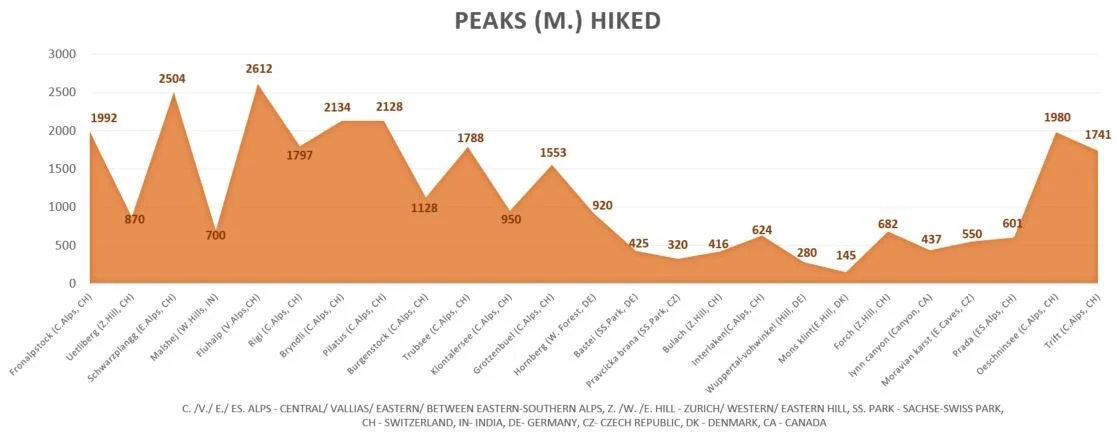
A chronological map of my hikes – The dip for the peaks accurately shows the winters, with most peaks closed (except for skiing) for hikes

A chronological map of my hikes – The dip for the peaks accurately shows the winters, with most peaks closed (except for skiing) for hikes

But these hikes were never just personal. Every hike made me a step closer to realize that how each of the path I was taking was not just unique in the amount of difficulty or type of exposure of the path (e.g. T1-T3, a scale to differentiate between different types of paths among hikers/ mountaineers). But it was extremely unique in the aspect of where it was and when it was formed. In one of the recent hikes I started noticing that the colors of the rock were extremely different even in the same Alpine range; the reason being that they had traveled from many different places and times to be finally settled there. And that was the start of the space-time revelation for me, or in very normal human words – an interest in geology of mountains and hills.  

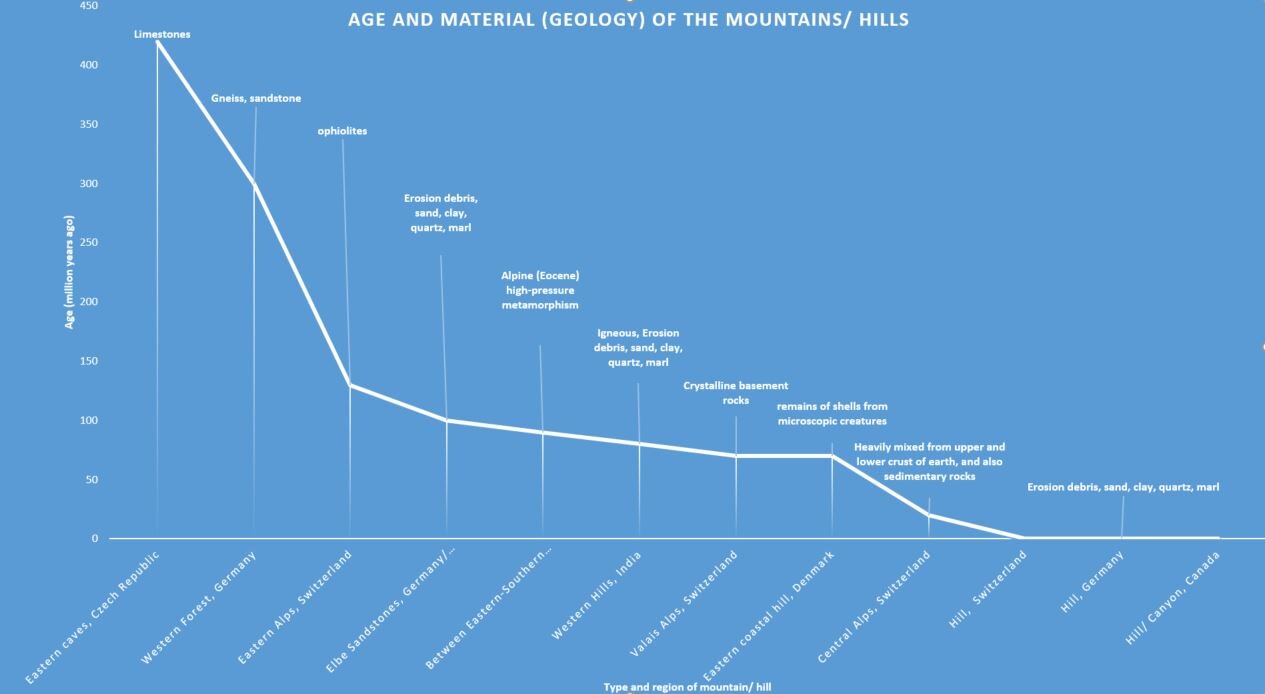
Because plots and geology are the new love, here is one more - on age of the mountain ranges

Because plots and geology are the new love, here is one more - on age of the mountain ranges

As far as I studied, the oldest place I have been to till now, is the caves in the eastern part of Czech Republic, called the Moravian Karst, with the history of the rocks there as old as 400 million years old, which means way before dinosaurs. This was an age called Devonian age, where the fishes were most prominent species. Moravian karst are filled with limestone caves to beautiful gorges, which are not just specific to the times of the fishes though, they also range till the Tertiary age (around 30 million years ago or 30 MYA), with the processes of orogeny (basically, processes of mountain formation where earth’s crust is folded and deformed). This is something not specific to the Moravian Karst, as I will discuss later, almost every mountain range or region has immense number of ages trapped in it’s layered formations. While hiking, if you are observant enough (I haven’t been always), you would see these beautiful layers even in the exposed rocks, with clear lines and different colors in a single rock.

The next wiser (i.e. older) place I traveled to in early 2019 was in Germany and it is one of the most traveled natural place of Germany - the black forest! The rocks in these forests age back to as old as 300 MYA with mostly a lot of Gneiss, granite and sandstone content. Gneiss is a common term for form of a metamorphic rock i.e. formed by multiple combinations of igneous (formed by volcanic eruptions) and sedimentary (formed with erosion and settlement processes) rocks. Black forest does not go very high (highest peak at around 1490 m), but it goes extremely wide (160 X 50 km) and has a very varied topology from grasslands to ridges, and multiple glacial lakes from more than 10,000 years ago.

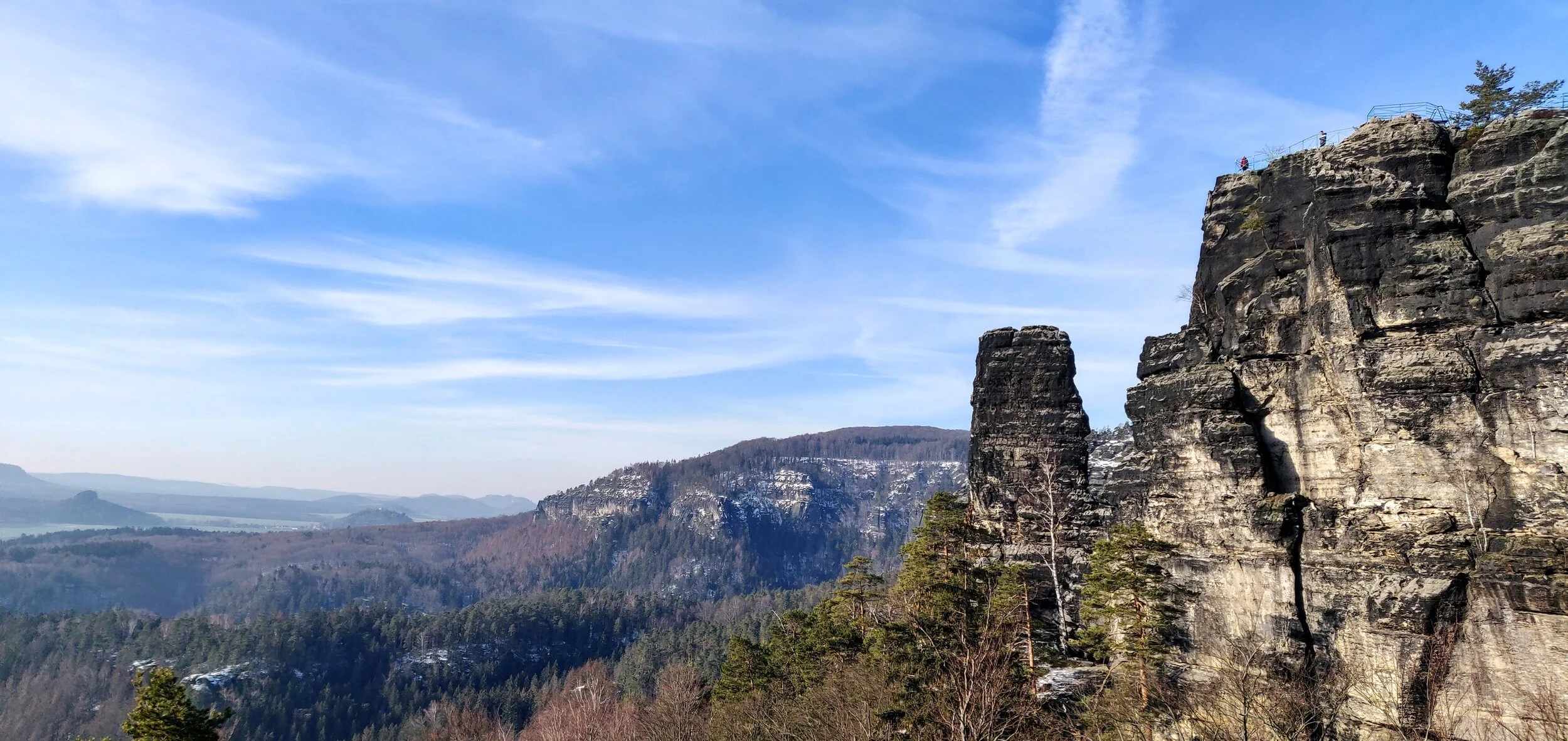
Having spent borders with Switzerland, Germany had to be explored more and thus I traveled to the other extreme (i.e. the east part) of Germany with other beautiful set of forests. The germans call it the Sächsische Schweiz or the Saxon Switzerland. This has peculiarly weird and extremely tall sandstone rocks standing alone and covering an entire landscape for about 100 square km. The mountain ranges are made mainly from the erosion processes from the Cretaceous period (around 70 MYA, or post-Jurassic times). This part is rich in mostly sand, clay and quartz remains as sediments of many river banks and the erosion processes have made bigger hills to just settle into large standalone rocks, adding to the beauty of the vast landscape.

The old and wise and much eroded, Elbe Sandstones

The old and wise and much eroded, Elbe Sandstones

Though I traveled a lot around the non-Swiss regions, the Swiss Alps were definitely the true-found love and most of my stories and research is from there. To be honest, I was extremely disappointed to find out that they are one of the very young mountain ranges. In fact, they are even younger than the Western hills (“ghats”) of India where I grew up. But I was extremely pleased to find that they are insanely complicated. Not a single mountain is like the other. They do have a similar story of formation, but looking at the vastness of the Alps itself none of the peaks can be same. So, as I understood from the different scattered studies on Alps, they are mostly divided in terms of geology as Western, Central, Eastern and Southern Alps. Some even consider the Western and Central as one group (mostly the Austrians, yeah, they are too proud of their Eastern Alps’ ranges). Swiss lies mostly in the Central Alps part. Except for three of the peaks I have been to which were Eastern and/or Southern, all have been Central.

The process of formation of Alps started more than 150 million years ago (MYA), but the recent peaks as we see them – even the tallest and one of the oldest one i.e. the Mont Blanc is just of the age of 6 MYA. The Alps were formed when the Adriatic and the European continents collided (as I imagined in my mind, it was not like a process of one explosion, and voila – Alps are here – it literally took millions of years). But the more interesting part is that Alps do not just have layers from these two continent collisions, but also the collision of the ocean basin (from the Tethys sea, Valais ocean, and very old oceans which existed then, and which do not exist as such any more) with the continents. Isn’t it amazing that the same mountains have layers of rocks from not just the oldest of ocean basins (sedimentary rocks), but also from the highly igneous rocks from many eruptions and different continents? Thus, Alps have literally been one of those biggest space-time revelations for me.

Why did they collide at the first place? Basically, Earth is very stable right now (except for the global warming fuck-up we are doing), but it was not millions of years ago – let’s say it was still cooling down – and the mantle’s movements, which is basically a liquid, (the layer of earth below the crust or the upper layer where we are based on) affected the crust and many tectonic plates as well. So, now that we know why the collision happened, we should be clear that these continents kept shifting all time and thus the process of the formation of mountains was stretched over millions of years. In fact, the erosions are still going on due to multiple glaciers everywhere on Alps. On a very general level, it can be said that the Central Alps (at least many of the mountains I have been to) are fairly younger than those in the more Eastern and Southern parts (majorly consisting of the Eocene metamorphic rocks, from around 60 MYA).

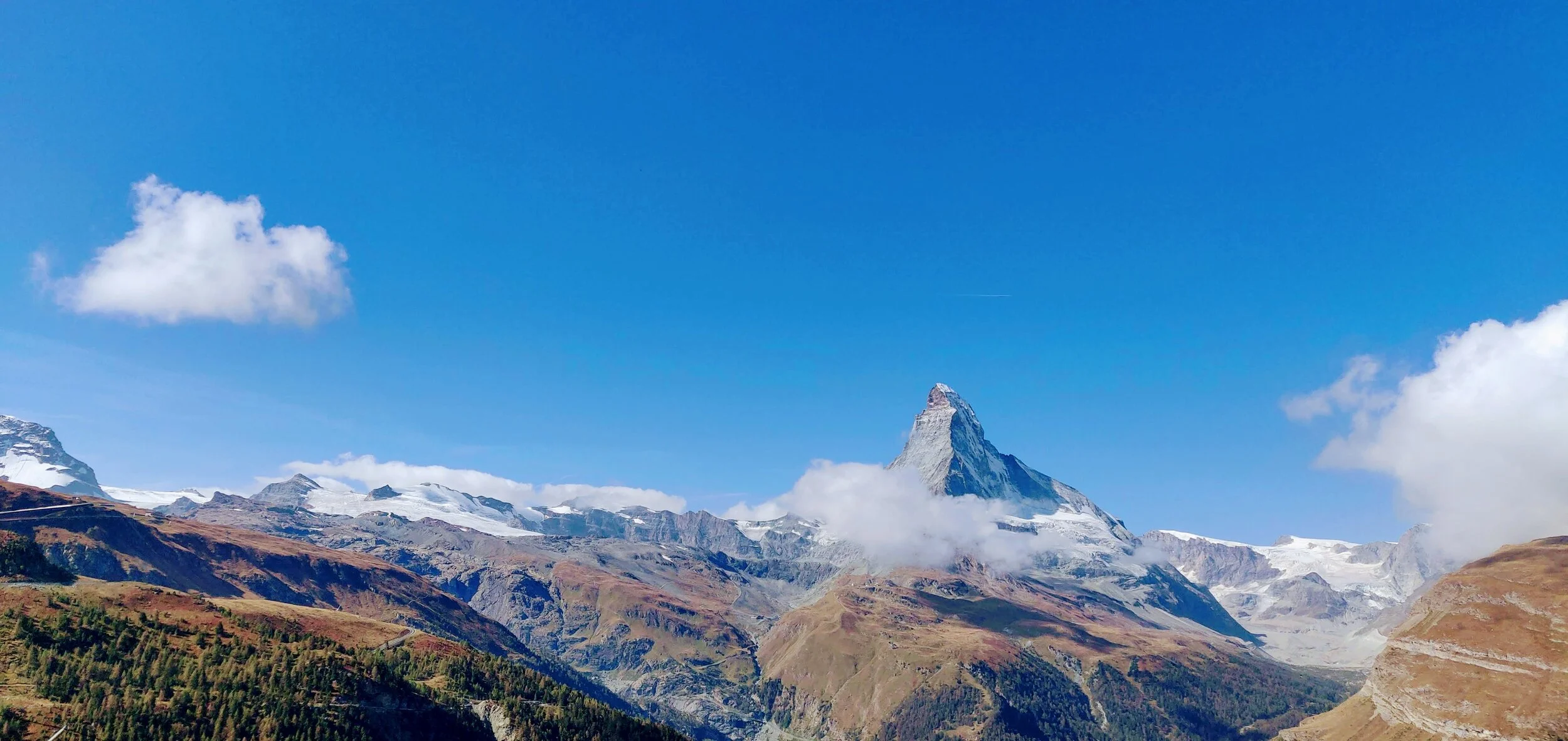
Some Alps memories, which have stuck with me from the central Alps, have been from the Valais region. The Matterhorn stands as the most mightiest mountain I have seen till date (said to be even tougher to climb than Everest). The Valais region have been studied in geology differently, especially the Matterhorn, as well. An interesting revelation to me about Matterhorn was that the older rocks are above the younger ones in this mountain. More interestingly, this is a very common trend around Alps that the older rocks are pushed in the process of mountain formation above the younger ones. In fact, Matterhorn has even a third layer i.e. of the sedimentary rocks at the bottom. Look up the YouTube links in the sources I mention below to understand how this actually happens; it is quite wonderful.

The mighty Matterhorn

The mighty Matterhorn

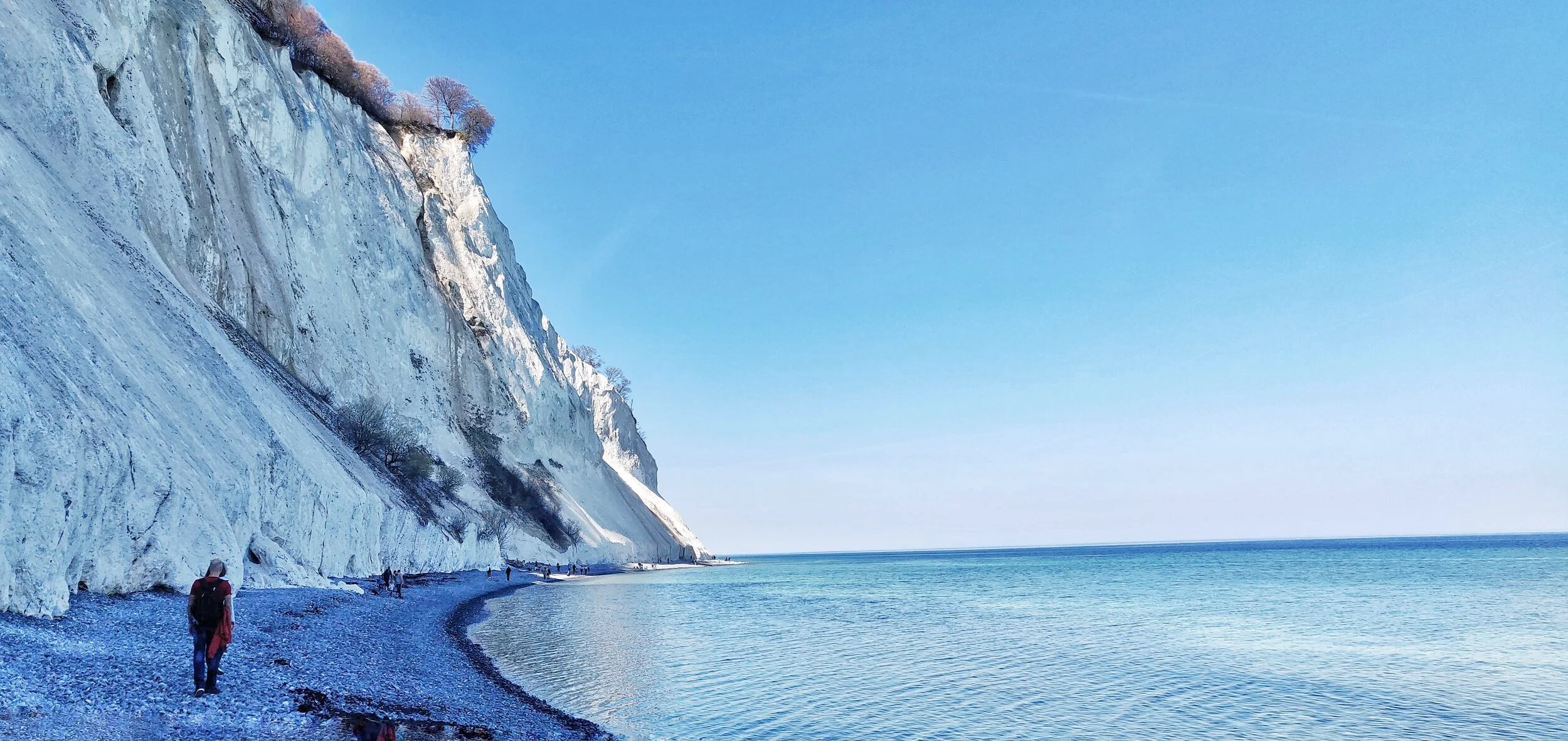
As much as the Alps and generally mountain ranges are always fascinating, I think we credit hills and canyons excessively less because they are basically small (and much younger). But I would like to talk about them anyways because they are not bad and I have been on them too much (I live on one!). Generally. So, the hills originate (usually) from river and glacier settlements or sediments. Looking at their ages, especially in Switzerland/ Europe and around Zurich, they have been quite young generally like 60-100,000 years old. Those in Canada, formed from the canyons of the rivers and especially the processes of erosions date back to around 70,000 years too. But then if we go a little spatially explicit, they can surprise you quite a lot. For example, those which we found at the edge of the coast of Denmark at Mons Klint are 60 million years old. And what they contain is more surprising – they basically feel like chalk or calcium, and we were surprised to find that it is from the shells of the microscopic organisms which lived in oceans/ seas millions of years ago. Crazy, right? The Indian hills are also quite old, formed mostly with many volcanic eruptions and sediments on the coast – more older in the Southern part of India – even older than the Valais Alps, and I found it extremely beautiful that I have grown up on them as a child.

The chalky hills in Eastern coast of the Denmark

The chalky hills in Eastern coast of the Denmark

I started writing this post or even doing this study because with time I have realized, walking on these hikes and every part of the earth I am on, that what we are experiencing in nature is not here just now. It has been here for literally 100s of millions years or it has at least travelled from millions of kiliometers. We need to respect that simple fact to be able to appreciate the beauty, and simply protect it. Everyday. Simple, right?

References and other good sources:

1.       Details on tectonics of all the regions of the Alps (one of the most exhaustive studies I could find)  - here

2.       Mountaineers classification of the peaks  - https://www.theuiaa.org/mountaineering/mountain-classification/

3.       Basins of the sea and the rocks types in Swiss - here

4.       For black forest details: https://www.nationalpark-schwarzwald.de/en/national-park/natural-environment/geology/

5.       About Moravian karst - https://www.gli.cas.cz/users/hladil/www/B2-Guidebook-MK.pdf

6.       The lynn national park and the mons klint have great ecological center to check out the geology of those locations in details.