Sustaining nonprofits: Understanding impact, missions and finance better

When we talk about not-for-profit organizations, it is commonly misunderstood that these organizations which are more focused on their mission for bringing better changes in the world, do not need any form of profit (surplus) for sustenance. But this is a misconception, as profits or surplus in any organization, help the organization to plan and sustain better for the future investments.

The majority of learning below are derived from the work in three books (arranged in order of relevance)

  1. Nonprofit Sustainability: Making strategic decisions for Financial Viability

  2. Forces for Good: The Six Practices of High-Impact Nonprofits

  3. Riding Shotgun: The role of COOs

Understanding trade-offs: Impact vs profit

First things first, how should we think about profit or surplus when impact is driving the organisation - which decisions need to favored in terms of finance, when and how? Here, I find the the framework from Book by Bell [1] and the matrix structure, which looks as follows, to be helpful:
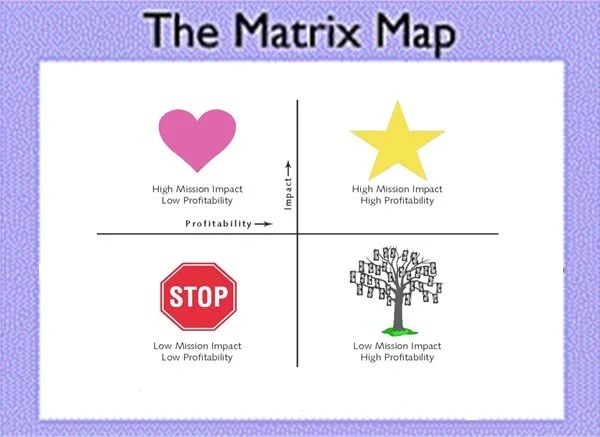
Impact vs profitability [Bell, Jeanne, 1]

This matrix basically helps decide which strategies to grow and in which direction, or when to act or stop a strategy based on their relative impact and profitability. While choosing any strategy or decision on , they need to be measured along the lines of this matrix. The stars with high impacts and profitability are most preferred, while those with low impact and profitability are mostly ignored. But how do we measure this impact for any strategy. Bell proposes a simple relative impact measure the strategies (to score them from 1-4) by looking at 7 criteria:

  1. Alignment of strategies with core vision

  2. Excellence in Execution

  3. Scale or Volume (of people reached)

  4. Depth (of impact)

  5. Filling an important Gap

  6. Helping Community Building

  7. Leverage (while comparing all programs of the organization)

Finally, it is important to involve most of the stakeholders and the leadership team of the organization, to do weighting (relative scoring) on each criteria to derive the final score for each strategy. Once this matrix map is ready with all the strategies/ activities of the organisation, the business model of the organisation looks clear and the fields where the board should be investing for highest impact and profitability becomes clear. An example for a community center shows it below:
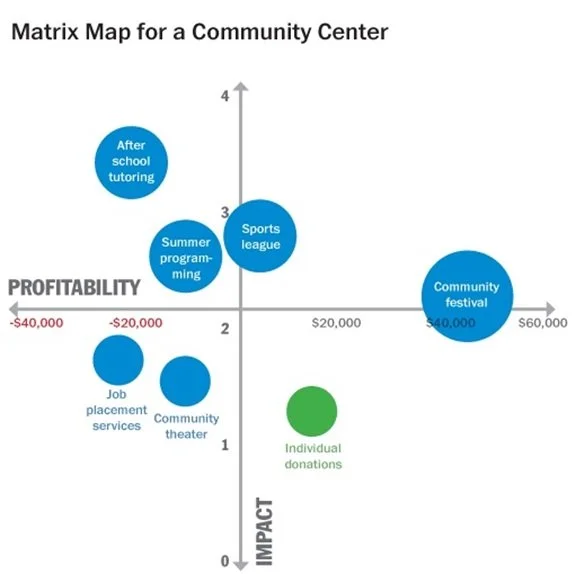
Matrix map example

For the above given map, the strategies in the organisation are added to each quadrant, and based on where they lie, next strategy is decided to obtain a financial impactful plan for the organisation.

  1. For high profitability, high impact or star strategies :It is quite straightforward to keep these strategies close to organisation and keep nurturing them

  2. For high profitability, low impact strategies: It is important to grow these strategies and invest in them to increase the impact (depth or reach-wise)

  3. With low profitability, high impact strategies are still preferred as they keep the organisation aligned with the mission of the organisation.

  4. While for low profitability and impact, clearly the strategies need to stopped as they drain resources of the organisation without much in return.

Understanding missions via Objective Key Results (OKRs)

At Humane Warriors, we felt the lack of focus due to the various projects with high impact we were doing. Thus, to understand our priorities and vision-mission better, we decided to use the structure of defining our activities better using the OKR system, usually used in large startups or organisations e.g. Google. As provided by our OKR consultant, Davor Vidic, OKRs are

✓ A method to help organisations crystalise their priorities, enable everyone to align into them and to create a relentless focus on growth and innovation

✓ The fuel for creating a growth and learning culture within the organisation

✓ An agile approach to motivating and managing goals in line with organisation strategy

✓ A powerful way of writing your goals (i.e. your Objectives) and your measures of success for assessing the impact it had (i.e. your Key Results)

✓ This will lead to the creation of an outcome-focussed mindset, rather than an output focussed one

While OKRs are not

✓ OKRs are not KPIs and should not be used to measure BAU

✓ OKRs are not a way to micro-manage or cascade targets

✓ OKRs are not a ‘Set and Forget’ goal setting framework

✓ OKRs are not a new measure for reward and compensation

✓ OKRs are not an excuse to beat people up for missing targets

Basically, Objective in OKRs helps explain what is to be achieved and why, while Key Results help in quantifying the ways to achieve these objective. Using again the slides of Davor, OKRs are the first step for the organisation to re-pivot themselves and align their vision-mission and quantify their quarterly to yearly financial and other goals. An example of the stages to achieve this is shown below.
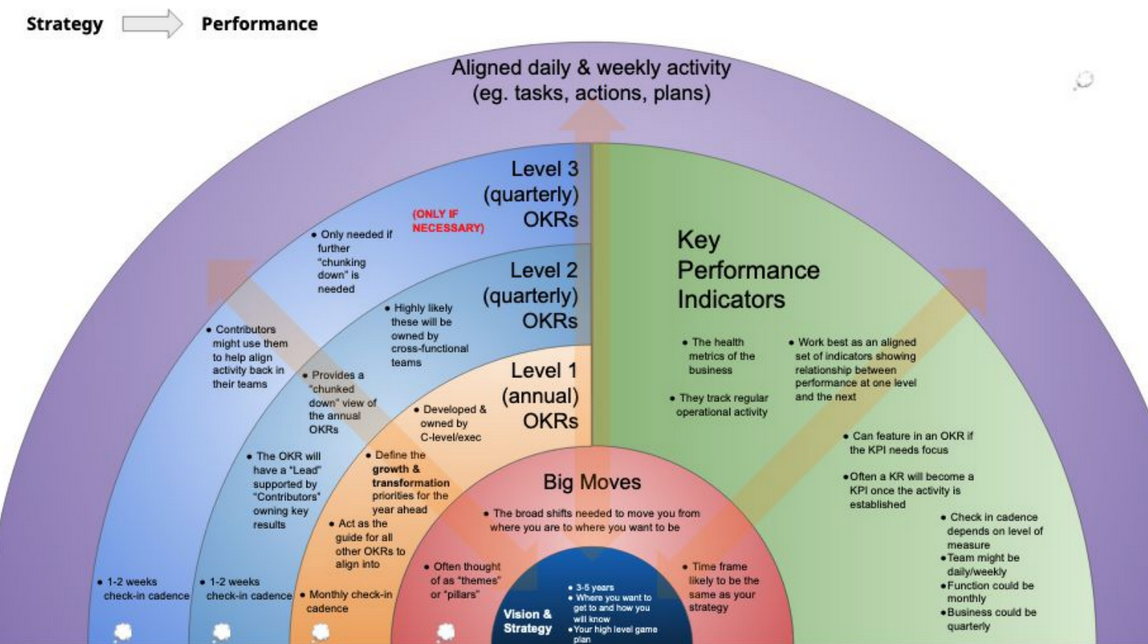
Steps to align everyday work from Big Moves to OKRs to KPIs

Understanding revenue streams

Once the organisation is more clear on the right strategies and its objectives clearly on periodic basis,it is important to understand what strategies can actually help bring more revenue to the organisation. Some of them are listed below, mostly focusing on donation streams.

  1. Internet Fundraising : Social Media, Website, Email newsletters,

  2. Major Gifts : Get loyal supporters including board members with significant financial means

  3. Annual Appeals and membership

  4. Direct Mail to a warm list

  5. Foundation Grants

  6. Corporate foundations

  7. Charity Sales and Scrips

  8. In-kind donations

  9. Earned income business lines

    1. Fees for Service

    2. Consumer-Paid Fees

    3. Government Contracts

Understanding impact best practices

As the last section of this blog, I would like to bring attention to the book by Crutchfield and Grant; Force for Good, where the authors interview 12 most impactful organisations and understand the practices which make them so impactful. Each one of them is discussed below:

  1. Advocacy and serve: Additional to grassroot involvement, these organisations add policy advocacy to access government resources or change legislation, thus expanding impact

  2. Nurture Nonprofit Networks: These organisations freely share wealth, expertise, talent and power with their peer (organisations), so that they can advance their field of impact.

  3. Make markets work: These organisations influence business practices, build corporate partnerships, and develop earned-income ventures - all ways of leveraging market forces to achieve social change on a grander scale.

  4. Inspire Evangelists: Great nonprofites see volunteers as much more than a source of free labor or membership dues. They create meaningful ways to engage indivdiuals in emotional experience that help them connect to the group’s mission and core values. They build and sustain strong communities to help them achieve their larger goals.

  5. Master the art of adaptation: As these organisations are highly innovative and even after failures, they have adapted to listen from communities, learn and modify their approach in response to external cues.

  6. Share leadership: The leaders of these organisations share leadership and build long tenures, and strong second-in-command to increase the overall impact from the organisation.


Tales of a year of managing crowdfunding campaigns during a crisis

Covid-19 slumped major economic players & corporates, leading to a major crunch of funds in every sector possible - leading to loss of jobs, and indicating need of more funds. But interestingly, this brought many individual players to the forefront filling up this gap of funds - at least, partially - through major crowdfunds. Not just many organisations picked up this cause, but even more started in this time to cater to help communities with the crisis. Humane Warriors started with similar cause to support vulnerable communities with lack of funds, bringing in the funds from those who had excess of them. Over course of 8 months, we ran 3 major crowdfunds, and 2 events to raise funds through individuals, contributing to the total of about 60,000 CHF (5 mil. INR).

What a crowdfund campaign paid for at Humane Warriors.

What a crowdfund campaign paid for at Humane Warriors.

The journey from starting the first-ever crowdfunding campaign at Humane Warriors, to managing external crowdfunding campaigns for organisations like Capacity (raised 50,000 CHF) was very rewarding, and no doubt filled with loads of learnings. So lets directly jump into them.

On crowdfunding

The network power

Crowdfunding is basically what it is literally - funding by crowd, usually the community members you are close to i.e. the first or second degree connections in your network. Thus, it’s success depends a lot on how large is your network and/or how large is the network of your first/secind degree connect. But just the size of the network is not to be looked for, what matters further is the effectiveness of this network. For example, if your network belongs to immigrants, a crowdfund aimed at immigrants’ integration program might be appealing to everyone - and thus it might be effective to mobilise this network for gathering funds.

Communication is the key

For success of crowdfund, it is very important to have the right communication tailored to the individuals of the network you are aiming to approach. That is why crowdfunding campaigns can be very demanding: as you might have to approach many individuals personally. One way is to divide your audience with the cause or the appeal of the crowdfund which might be interesting for them, e.g. some of them might be interested in the cause, others in the perks of it, etc.

Lot, really a lot of planning

Like any other project, crowdfund needs an immense amount of planning. As crowdfunds usually are limited by time, or they lose interest within an average duration of a month, you have to keep attention of the crowd intact in this short span of time. There are lot of tutorials and templates which can help you in planning your crowdfund well before you launch it - but mostly the pillars to focus on are

  • what: are you offering? why is it unique to this crowd?

  • who: are you offering it to?

  • why: what is your cause to offer it? this is crucial for strong connection with your crowd.

  • how: are you planning to keep your crowd engaged

    • during (your communication medium/ strategy during the entire crowdfund, e.g. you can start a complete new medium for attracting and hooking the audience to the campaign, and potentially recurring donations.)

    • after the crowdfund (e.g. the perks as return of the donation, to keep your audience attached to the project and maintaining a good customer/ donors base for future)

Timely communication is key

Timely communication is key

Role of intuitions and risks involved

When I was working with the Capacity Zurich team, I heard a lot of time the sentence which started something like “I feel …. would be willing to contribute … “. Being a quantitative person, I was not very willing to give a lot of weightage to “feels” - as I wanted actual numbers of potential supporters to estimate the target amount for the campaign. But refering back to the first point in this list “the network power”, it was clear that the proximity and effectiveness of the network is difficult to be guaged quantitatively, and this is a calculated risk you and your team members should be willing to take.

Can corporates be included?

Yes and no, depends on your goals, cause and (existing)partnerships. Though corporates tend to support crowdfund for (1) a non-profit cause as a part of their corporate social responsibility programs, or (2) a for-profit project as a potential investor, or (3) just as a support towards a partnering organisation, the returns are quite low in each case for the corporates to be involved. But, a trick to lure in the corporates could be through the perks of the crowdfund itself e.g. providing an exclusive session for corporates in your expertise, or exclusive executive presentation related to your project updates by the core team.

On teams

Ousider and insider in the team

As an insider (in the core team) at Humane Warriors, and as an outsider (supporting the core team) at Capacity Zurich, the crowdfunding experiences were quite different. The former had the advantage of knowing the team better and thus the campaigns were easy to be built with the up to date access to information on the team needs and resources. At the same time, being an outsider allowed out-of-box thinking: innovative marketing and audience-targeted approaches.

Capacity’s crowdfunding team

Capacity’s crowdfunding team

Talent and partner mapping

With a diverse team, and like for any other project it is quite crucial to map the talents in the team to the evolving tasks of the crowdfunding to keep it sustained and successful. For example, a team member who hesitates to make personal requests to the donors, should not be on the forefront of the communications of the campign.

Also, when we are talking about the network of the team, it is important to include the network of the partners as well. A dedicated communication (and team member(s)) needs to be set up for this extended network, especially for the partners who are close knit to.

Team culture

As you are closely involved with the audience of the campaign, your culture can be very-well exposed to the audience, so be aware of it. Usually it is an advantage, e.g. if your team is very inclusive, and you are working on a campign on gender inclusivity at workplace, it can play a very significant role in bringing dedicated donors.

Looking back at the overall experience, no doubt that additional to these learnings on crowdfunding and team managements, there were many personal learnings from these campaigns. While working with multiple people: donors and team members, I noticed my subtle transition from many self-doubts (‘I don’t know this’) towards small self-discoveries (‘this is what I don’t know, what I know’), and I will always remain grateful for this experience.

On Networking: Share, Learn, Grow!

Networking is fairly very new field for me - or lets say, it has been very recent that I am finally able to formalise it a bit more. Being an ambivert, it is not always easy for me to network, and thus I decided to divide networking into three main goals: Sharing, Learning and Growing. Additionally, corona crisis has made it tougher, and ironically more necessary (with growing rate of unemployement) to network. Hoping that setting these clear goals in terms of audience, skills and challenges, can help many more to network better and more efficiently.

Photo by Clarisse Croset @herfrenchness on Unsplash

Photo by Clarisse Croset @herfrenchness on Unsplash

Sharing

  1. Audience: Building and connecting to your own ‘tribe’ -> an identity you associate to 

  2. Skills to share: Something you are good at and you can share with confidence, impart knowledge, build trust and help others grow, e.g. for me, it is the experience of masters and education abroad.

  3. Challenge: This is the easiest network to build as you are an expert at it and people tend to join you. But the challenge can be filtering many requests you can get once you are open. So try to gauge time well (e.g. limit the number of calls and/ or streamline the appointments by dedicating certain time per month for these commitments), and remain kind and patient with people who are beginners (remember you were one, once upon a time). 

Learning 

  1. Audience: Building a network of people who are enthusiastic learners or those you seek to learn from.

  2. Skills to learn: Focus on the skills you lack the most, and lack of this has stopped you to grow in your current field or hinder you from new experiences, e.g. for me, it is management. Also, my german skills!

  3. Challenge: This network is toughest to build - so try to remain vulnerable, and be open to sharing your failures, and go with the pure intention and request to learn. Be very clear about why these new set of skills would help you and others. 

Growing

  1. Audience: Building a network of people who learn from you and you learn from them - almost equally. There is always something to give and take in these setting of networks 

  2. Skills to grow: What you are currently good at - and plan to remain good at for a long term, e.g. this could be the industry you work for e.g. for me this is field of sustainability

  3. Challenge: This network is easily available but not always accessible due to competition, or if you belong to a minority in your industry (e.g. expats, etc.). Try to be very crisp about your needs from this community and be more open to helping others out (without any expectations), this might pay-off later well. 

Happy networking!


P3S2: A tool to push creativity while multi-tasking

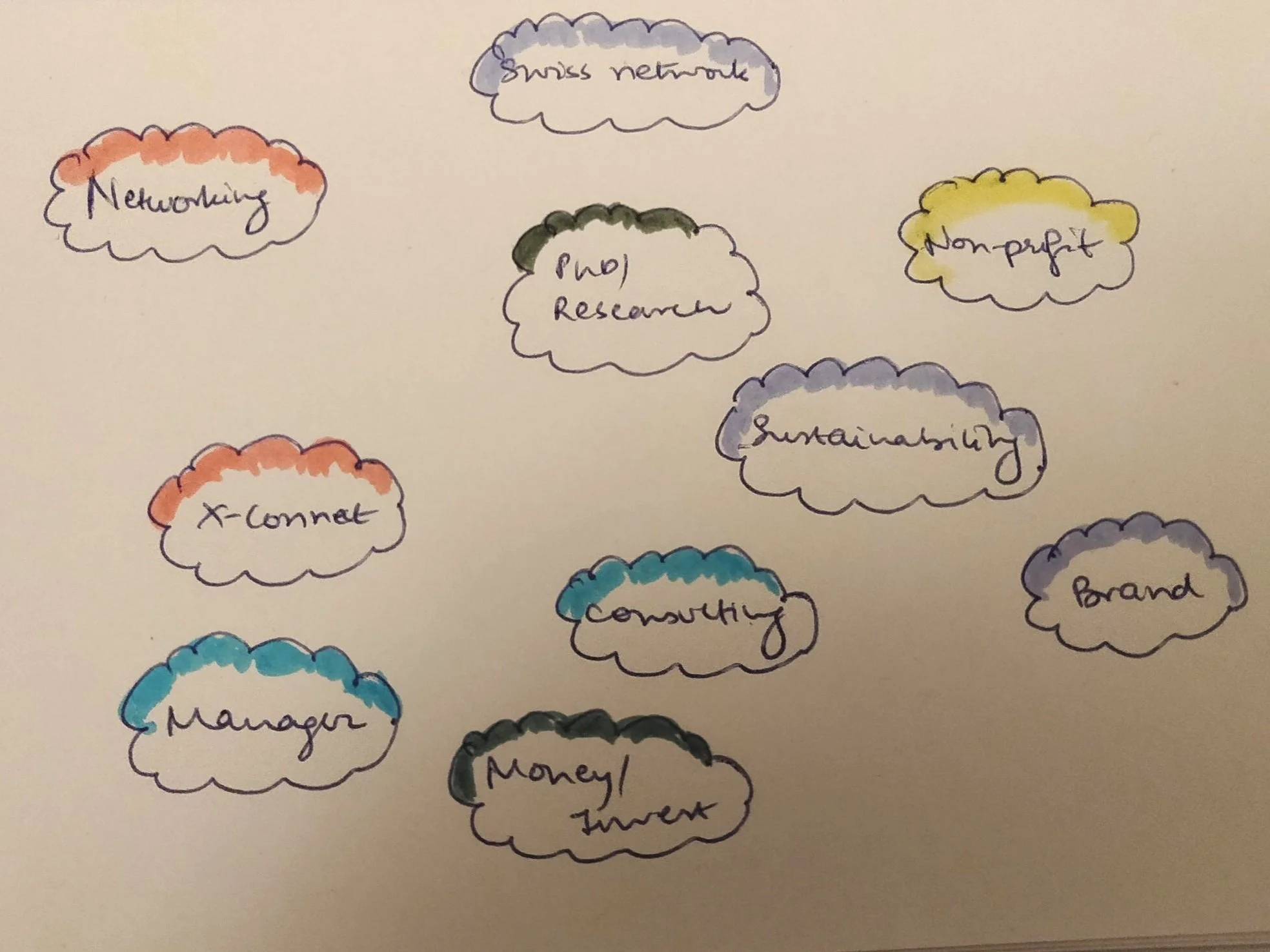
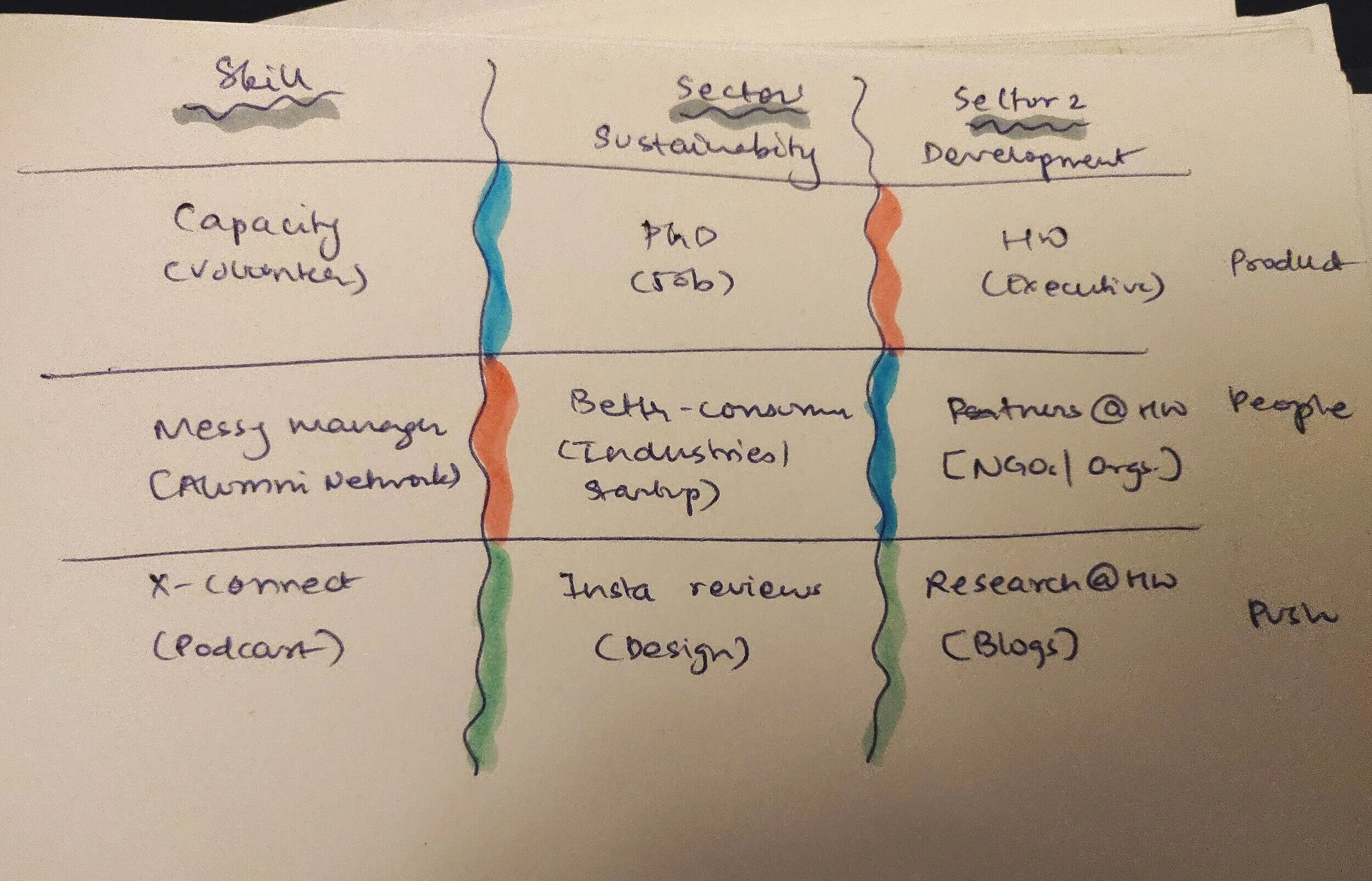
Last Saturday, I woke up in the middle of night at 3 am, confused. I dreamt that my non-profit team manager was complaining to my PhD supervisor about some work conflict in the company I volunteered at.

So two things were clear - (1) My work(s) was hindering my health (again), which is not a good sign at all, and (2) I was multitasking too much and I needed a structure to manage the limited time (resources) I had in 24-hrs-day. So, I took out my bedtime-notes notebook (yes, I keep one for badly-sleeping days) and started scribbling it with the words which were messing up my head. And I added some bubbles, for well, just some nice effects.

Below you will find many of my scribbles, but here you can find a sheet/ tool here as well - which you can download and get going to push you multi-tasking creativity!

IMG_20201018_193925.jpg

It was all over the place, and no doubt I was not able to sleep well. But at least I had some big words floating in my head - on a piece of paper. So I took a glass of water, sipped it down, and went back to bed with a little bit of relief. 

But there was still a lingering thought which kept me restless - why am I doing these multiple tasks - and does it mean that it is coming at the cost of creativity in one or many tasks - because I did not have enough time? But this was a question for the next morning. 

Move Bubbles to Actions

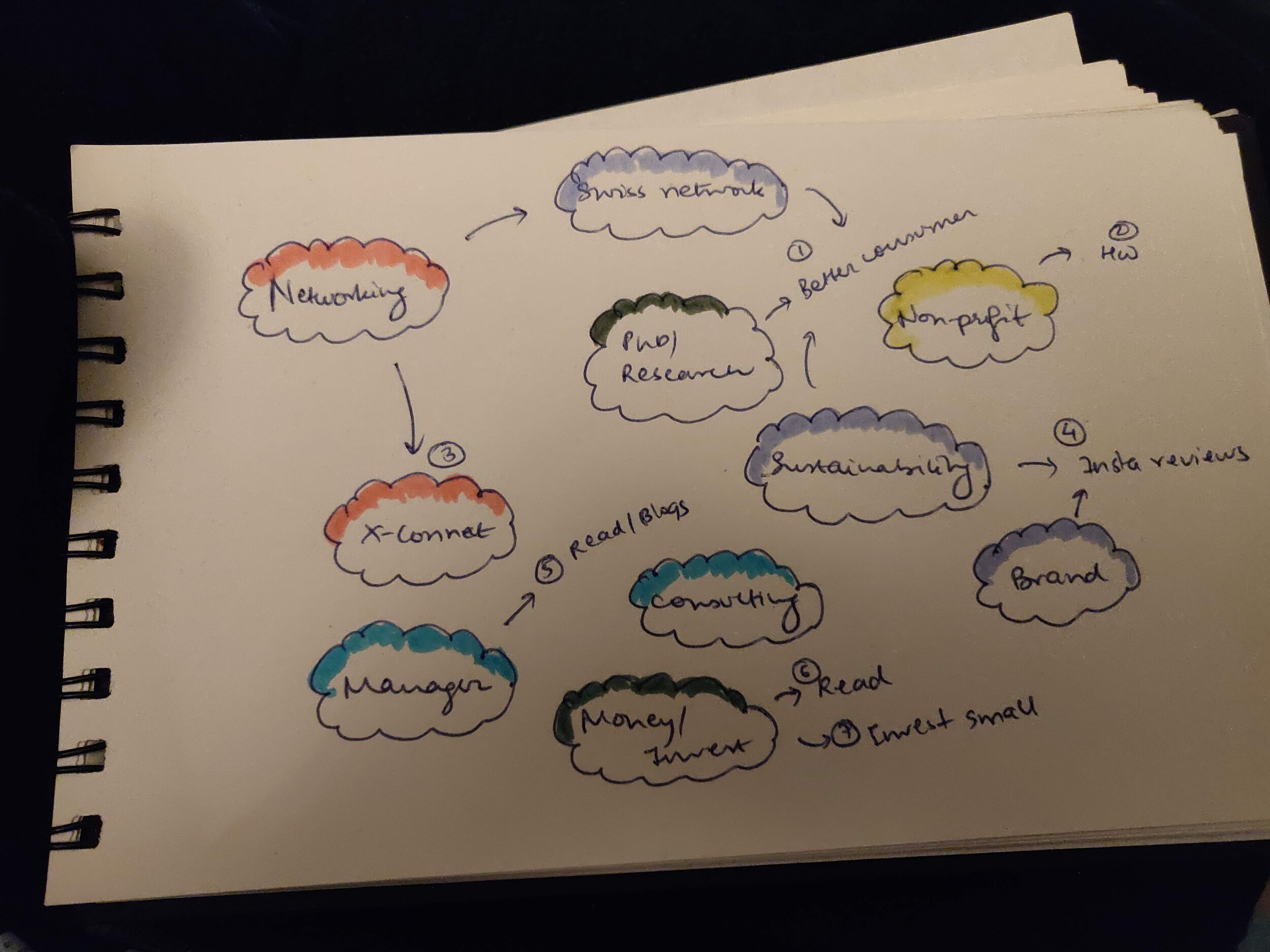
Next morning, after 3 hrs of therapeutic cleaning of the house, I decided to sit down with these bubbles. The first step was to associate them to something more concrete - something I could comprehensively analyse - and the best way was to start with the current set of concrete actions I do everyday. So, I started adding actions in the current set of bubbles. 

IMG_20201018_194233.jpg

Move Actions to Priorities

Also, I had to be aware I was very limited in my personal resources - basically, time. So added to these actions, I needed a clear idea of what I prioritized the most - but given my background as an extremely curiosity-driven person (saying yes to anything which looked new and shiny) - this was not an easy step. Basically, it demanded discipline of choices, which I mostly lack.  

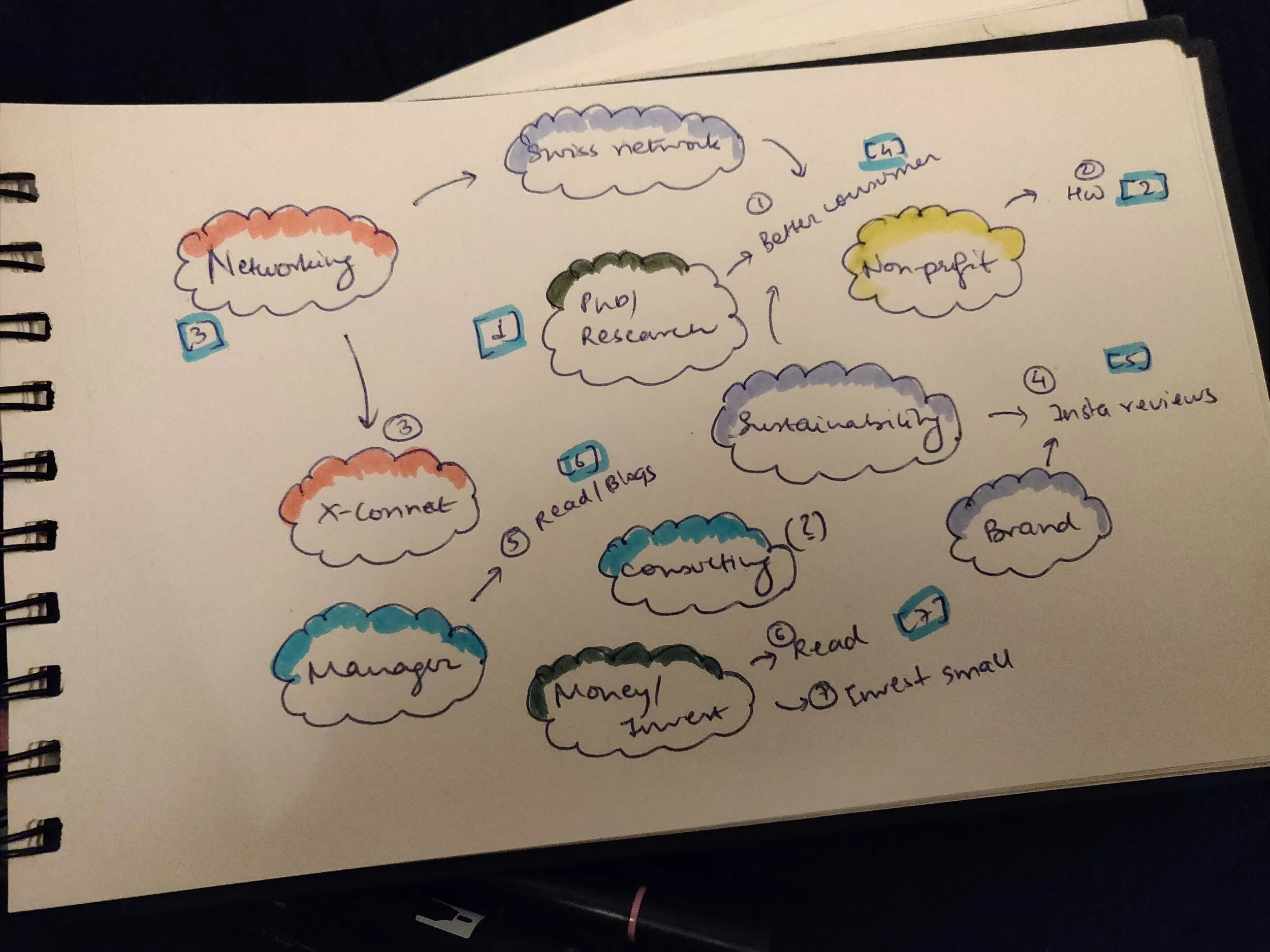
I approached priorities in two ways - (1) ranking the entire cluster (bubble) of actions - what was most important to me (2) what was drop-able inside each of  these clusters, keeping in mind resource constraints. So I also started ranking them internally in the clusters. 

IMG_20201018_194425.jpg

Move Priorities to Domains

Though I was able to rank them, I could still see that some of them had very clear similar priorities - but they belonged to different domains of actions. For example, I was very clear that some of these actions were focused on my skill development, while some of them were focused to help develop my knowledge in the sector/ industry I work in. 

Move domains in Skills/ Sectors (S2)

So the first step was to separate these prioritized actions into separate sets of engagements in either sectoral-development or skill-development. Note, ‘development’ is a word I use for something which is also steady in nature - e.g. your current job can just be our ‘development’ in your sector, and not mostly challenging your skills. 

Sometimes, it is both challenging your sectoral and skill-knowledge, and then you can add them in both the segments - but be clear on adding the knowledge which this job hones in the sector segment, and the skills which the job nurtures in the skill segment! 

Also, sometimes, e.g. in my case, you might be engaged in more than one sector and you might have a common set of skills across them, so be creative and practical on how to add it in your chart.

Move domains to Product/ People/ Push (P3)

Now that I had clearer priorities and actions, I went back to the lingering question and challenge of creativity while multitasking. For that I needed to clearly know which set of prioritised actions I could push more, and if I could push them, what was the tool to do so. Was it through people/network-activities or through a product/service? 

But before that, I had to be clear how my current network (people) and current knowledge and expertise (product or service, I was engaged in) was equipping me towards it.

IMG_20201018_195251.jpg

I call this simple table as P3S2 - Product and People across Sector and Skills -> to define your Push! Overall, this tool has helped me to categorise my efforts in different activities I multitask - and thus understand best, how and where I want to push my creativity. Hope it helps you too!

Building innovative team (culture) - resources

As a part and culture of Humane Warriors, we are always questioning about how we reamin innovative in our approach to bring creativity and innovation with each our volunteer and team member. To do this, we have read through multiple material, heard podcasts and we are reading several books. But above everything, we belive in sharing our knowledge with all, thus here are some resources and notes on them, which we felt worth exploring.

_MG_1557.jpg

Something core to creating innovative team is to first Foster an innovative workplace (Some tips below by ReWork, Google)

  1. Shared vision - Make sure everyone knows where the organization is heading. (Is HW clear about this in the first place? :shrug:)

    1. Set objectives and key results (OKRs) to achieve your vision. At Google, OKRs are set at company, team, and individual levels each quarter. OKRs communicate where you’re headed and how progress will be measured

    2. Question your core values -> and dedue them to purpose (why), mission(how), strategy (what), and goals

    3. Tools to conduct the Vision-Mission of team

      1. [re:Work] Building A Shared Vision Slides 

      2. re:Work | Building A Shared Vision Session

    • Autonomy - Allow employees to define their own work as much as possible.

      1. Foster a culture of learning: volunteer-to-volunteer meet up and learning

      2. interdepartmental connections,

      3. Suggestions and not mandates

  • Intrinsic motivation - Hire naturally curious people who like to learn.

    • Risk-taking - Enable employees to feel psychologically safe to take risks and try new ideas.

    • Connection & collaboration - Make it easy for employees to find partners and work together.

Recommended book reading: The Making of a Manager by Julie Zhuo  

  1. As a manger, have a multiplier effect for the team and not additive (e.g. teach skills, or learn skills for and with the team, rather than doing the same process as everyone which might take same/ more time)

  2. Know yourself: know that if you are a leader or a manager -> 

    1. You can be a leader without being a manager, but not vice versa 

    2. Do you really really love being a manager (people’s person?) 

Something which has helped us (at Humane Warriors) has been the postmortem exercise and here are some of the tools to make yours: [re:Work] Postmortem Exercise and [re:Work] Premortem Guide  

Hope these simple list of tools help your team remain innovative!